
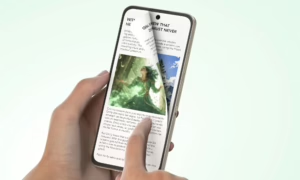
At MWC 2026 in Barcelona, TCL announced that its NXTPAPER display technology — the company’s branded stack of anti-glare, blue-light reduction, and paper-like rendering features — is moving onto AMOLED panels for the first time. Until now, NXTPAPER has lived exclusively on LCD-based devices, where matte surface treatments and blue-light filtering made sense as a way to soften the inherent harshness of backlit liquid crystal. Bringing those features to a self-emissive OLED substrate is a meaningfully different engineering problem, and TCL’s willingness to attempt it in public, at MWC, suggests the company believes it has solved enough of it to stake a market position.
The announcement travels alongside two concrete products: the NXTPAPER 70 Pro smartphone, which ships with the current NXTPAPER 4.0 LCD-based implementation, and a refreshed tablet lineup that extends the NXTPAPER brand to larger screens aimed at education, hybrid work, and long-form reading. The AMOLED version is being shown as a concept phone at this stage, but the direction is deliberate. TCL and its panel subsidiary TCL CSOT are positioning eye comfort as a feature category in its own right — not a footnote in a spec sheet, but a named technology stack with its own roadmap.
What NXTPAPER Actually Does, and Why AMOLED Complicates It
NXTPAPER’s core proposition has always been to close the gap between screens and paper. The LCD version accomplishes this through a combination of a matte nano-etched surface that scatters specular reflections, multi-layer blue-light filtering that reduces harmful blue output to around 3.41% of total light without the yellowish cast of software night modes, DC dimming to eliminate high-frequency PWM flicker, and a suite of adaptive software modes that adjust brightness and color temperature according to ambient light and time of day.
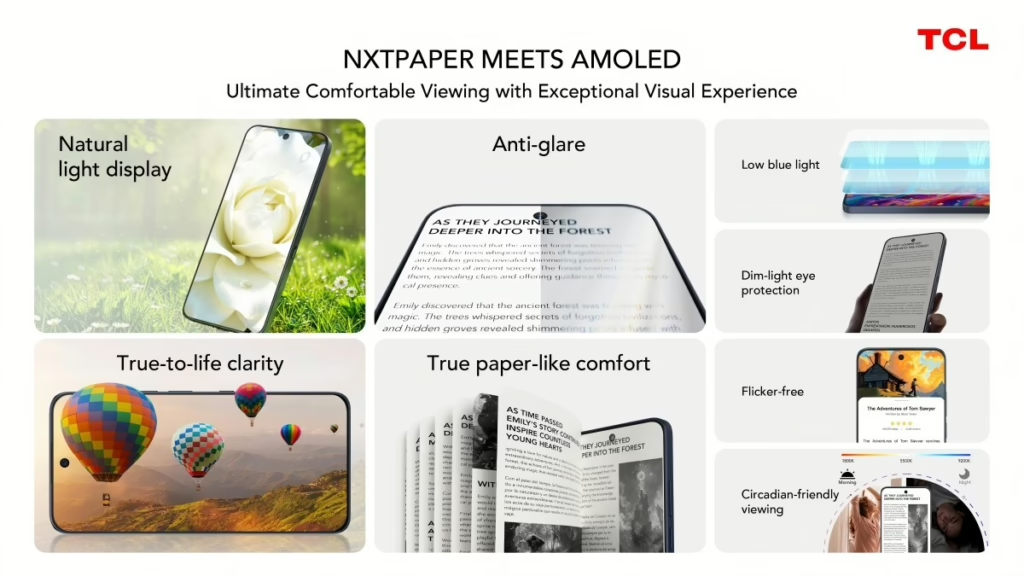
Translating that to AMOLED introduces complications on both sides of the equation. On the benefit side, OLED is self-emissive and can dim individual pixels to true black, which makes low-brightness viewing and dark-room reading more comfortable in ways LCD cannot match. On the challenge side, most OLED phones use PWM dimming at low brightness levels — a method that achieves a dim image by rapidly flickering the panel on and off at frequencies that some users perceive as eye strain or headaches even when they cannot consciously detect the flicker. Anti-glare surface treatments present a separate engineering problem: standard AMOLED panels ship with smooth, glossy glass over the emissive stack, and adding a matte or nano-textured layer risks introducing haze, grain, and color shift that undermines the very image quality OLED buyers expect.
TCL’s solution addresses each of these in turn. The new NXTPAPER AMOLED panel uses DC dimming throughout its brightness range, including at the very low end, where the display can reach approximately 1 nit while remaining flicker-free. This is the spec that matters most for bedtime reading and late-night use, and it is one that standard OLED implementations regularly fail. Blue-light output is reduced further, to roughly 2.9% of total light, compared to 3.41% in NXTPAPER 4.0, a 15% improvement that TCL says is achieved without compromising the panel’s ΔE color accuracy of below 1 or its 100% P3 gamut coverage. The anti-glare treatment uses nano-matrix lithography — a fine, patterned surface tuned for AMOLED optics — that TCL describes as the first AG solution implemented on a smartphone AMOLED panel. Whether that claim holds on scrutiny remains to be verified by independent reviewers, but the hands-on coverage from MWC described noticeably reduced glare compared to standard glossy OLED phones, without the visible grain typical of matte LCD surfaces.
The Polarizer Upgrade and What It Signals
One technical detail in the announcement deserves more attention than it has received in early coverage. TCL’s Circular Polarizer Light system, which shapes how emitted light exits the panel and interacts with the viewer’s eye, has been upgraded from roughly 57% polarization efficiency in NXTPAPER 4.0 to approximately 90% in the new AMOLED implementation. Polarization efficiency is not a spec that appears in mainstream consumer marketing, but it matters for visual comfort: more completely polarized light is closer in character to the diffuse, non-glaring illumination of natural environments and printed surfaces, which are the conditions under which human vision is most relaxed over extended periods.
The jump from 57% to 90% is substantial, and it indicates that TCL and CSOT have invested in polarizer component development specific to this application, rather than adapting off-the-shelf OLED optical stack components. That in turn signals something about the seriousness of the project: this is not a marketing overlay on a standard panel, but an engineered modification to the optical path.
CSOT’s Strategic Bet
The corporate logic behind NXTPAPER AMOLED is as important as the technology. TCL’s display manufacturing arm, CSOT, is one of China’s most advanced panel makers, with significant AMOLED capacity and ambitions to compete for supply agreements with global OEMs. The conventional CSOT pitch to a European or American smartphone brand has been primarily about competitive pricing and improving baseline OLED quality metrics. NXTPAPER AMOLED allows CSOT to pitch something different: a differentiated module with a defined feature identity, hardware-level eye-comfort certifications, and a consumer brand (NXTPAPER) that already has recognition in the tablet and value-smartphone segments.
The market this most directly addresses is the education and enterprise space in Europe, where national and regional regulators have been paying increasing attention to screen time, blue-light exposure in classrooms, and occupational health guidelines for display-intensive work. TUV and SGS eye-comfort certifications have moved from nice-to-have to table stakes in procurement conversations for school tablets in several EU markets. If CSOT can supply NXTPAPER AMOLED modules to OEMs serving those segments, it positions Chinese panel technology as a health-conscious alternative rather than simply a cost-efficient one — a reframing that could open doors that price arguments alone would not.
The Broader Context: Korean OLED’s Blind Spot
TCL’s AMOLED move lands at an interesting moment for the Korean OLED supply chain. LG Display’s recent 100% dimming consistency certification from UL Solutions, and Samsung Display’s continued refinement of QD-OLED, have both centered the Korean OLED story around peak brightness, color volume, and contrast metrics. These are legitimate and important quality dimensions, but they are also metrics that skew toward HDR television viewing, professional monitors, and gaming — high-intensity, relatively short-duration use cases.
NXTPAPER AMOLED is aimed at the other end of the usage spectrum: the hours spent reading email, annotating documents, checking news, and scrolling through text on a phone or tablet. These are the sessions that generate the most screen fatigue complaints, and they are the sessions where raw peak brightness and color volume matter least. By staking out that territory with a coherent, named technology stack, TCL is identifying a gap in the Korean OLED narrative and filling it with Chinese panel technology. Whether it succeeds will depend on whether ‘healthy OLED’ resonates with consumers and procurement teams the way ‘brighter OLED’ has resonated with reviewers and retail sales staff.
The honest caveat is that the clinical evidence behind specific blue-light reduction percentages, going from 3.4% to 2.9% of total output, remains contested. Ophthalmology researchers have questioned whether the blue-light framing overstates the role of spectral content relative to total brightness, duration of use, and viewing distance as drivers of eye strain. TCL’s multi-dimensional approach — combining blue reduction, flicker elimination, glare reduction, and circadian adaptation — is arguably more defensible than blue light alone, since it addresses several plausible mechanisms simultaneously. But consumers and buyers should approach the specific percentage claims with appropriate skepticism until independent clinical review catches up with the marketing.
What is harder to dispute is the anti-glare engineering. Glossy AMOLED has been a real-world usability limitation for outdoor reading since OLED phones became mainstream, and a matte AMOLED surface that preserves sharpness and avoids the grain penalty of most matte LCDs would be a genuine quality-of-life improvement for a large share of daily use scenarios. That is the claim TCL is making, and it is the claim that hands-on reviewers at MWC found credible in their brief exposure.
The full test will come when NXTPAPER AMOLED devices reach mass production and independent display measurement labs, extended reading sessions, and direct comparisons with standard AMOLED phones. For now, TCL has identified the right problem, assembled a plausible solution, and chosen the right venue to announce it. The rest of the industry — Korean suppliers included — will be watching whether ‘comfortable OLED’ becomes a buying criterion, or remains a niche differentiation in a market still largely driven by brightness numbers.