
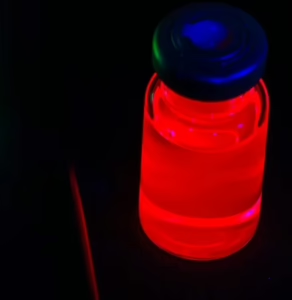
Nanosys showed a prototype display at CES 2026 that replaces the conventional single-peak red subpixel with a deliberately engineered dual-peak spectrum, combining a 620 nm component for brightness and efficiency with a 650 nm “deep red” component that overlaps wavelength bands studied in photobiomodulation research. The company framed the concept as “better for you pixels” rather than a medical treatment, positioning it as a new display category where spectral characteristics become a user-facing feature.
The approach leveraged quantum dots’ ability to produce narrow, tunable emission peaks, making it feasible to stack two red components within a single color channel without the brightness penalties associated with broadband filtering approaches.
The Dual Red Architecture
The technical challenge Nanosys addressed is the deep red efficiency penalty. Wavelengths in the 650-670 nm range are perceptually dimmer and less energy-efficient than shorter red wavelengths, creating a tradeoff between spectral characteristics and display performance.
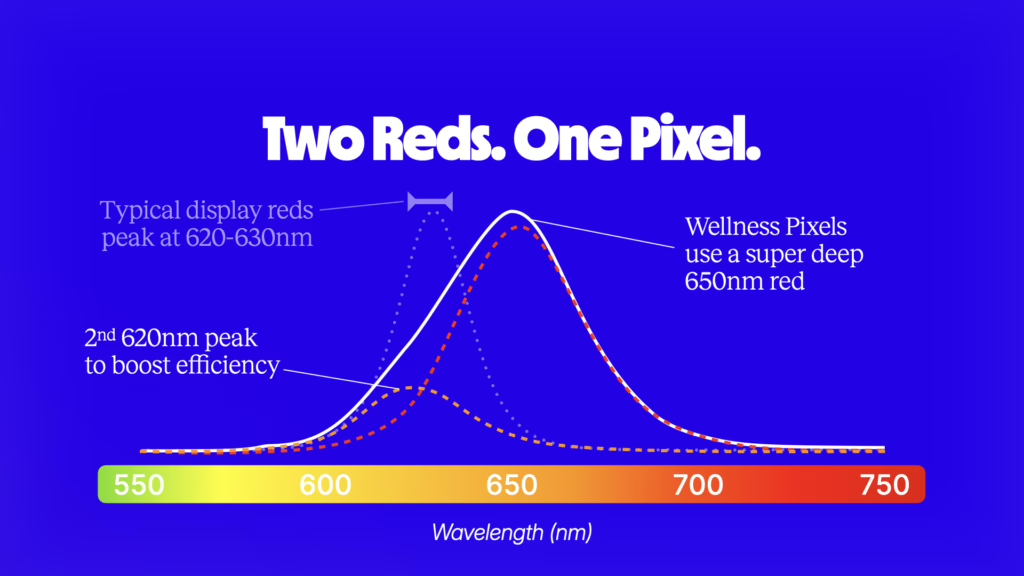
The 620 nm component served as the “utility red,” providing the brightness and efficiency needed to maintain standard luminance and color volume targets. The 650 nm component anchored what Nanosys called the “wellness red,” pushing into wavelength territory closer to bands used in photobiomodulation experiments, typically clustered around 630-670 nm for eye and skin applications.
By combining both peaks, the display can render conventional content while increasing the fraction of deep red photons per unit of red light output compared to typical LCD or Mini-LED displays using single broadband red phosphors. The quantum dot approach produces this dual-peak emission directly rather than filtering broadband light, meaning all emitted deep red photons actually reach the viewer without the brightness loss associated with absorptive color filters.
Photobiomodulation research has examined light in the 600-1000 nm range, with eye-specific studies often focusing on 630-670 nm and 780-850 nm bands. In one widely cited study from UCL, a single three-minute exposure of 670 nm light in the morning produced an average 17% improvement in color contrast sensitivity in subjects over 40, with some individuals improving approximately 20%. The same protocol applied in the afternoon showed no measurable benefit, and subjects under 40 generally did not improve, indicating both time-of-day and age dependencies.
The proposed biological mechanism centers on mitochondrial function. Photobiomodulation theory holds that long-wavelength red and near-infrared photons are absorbed by mitochondrial cytochrome c oxidase, boosting ATP production and altering cell signaling. In aging retinas, where mitochondrial efficiency declines substantially, brief 670 nm exposure appears to improve energy availability in photoreceptors.
Nanosys borrowed this photobiomodulation narrative but explicitly stopped short of health claims, emphasizing that the prototype is not a medical device and that future work must establish exposure levels, safety standards, and measurable outcomes. The distinction mattered: relative to dedicated red light therapy devices that deliver high-irradiance 630-670 nm or 800+ nm light for minutes-long sessions, a monitor delivers much lower per-minute dose but over potentially many hours of casual exposure.
From a display engineering perspective, the dual-peak approach presents both opportunities and challenges.
The quantum dot spectral engineering avoids the brightness penalty of software filters or absorptive optical elements. The concept aligned with the broader multi-primary trend visible at CES 2026, where vendors explored dual blue backlights, added cyan and yellow primaries, and multi-red configurations for gamut and efficiency improvements. This made integration into emerging color science workflows more straightforward than a fully proprietary spectral approach.
The tradeoffs centered on efficiency, color management, and validation. Deep red remained perceptually less efficient, so achieving sufficient 650 nm output without noticeable brightness loss or color shifts required careful tuning and likely some sacrifice in peak efficiency versus a pure 620-630 nm red primary.
Color management complexity increased as well. Content is still authored for three primaries, but the red primary now had a structured spectrum that might interact differently with human vision and measurement instruments, particularly for HDR mastering where spectral assumptions underpin the entire workflow.
The safety and effectiveness questions remained open. Photobiomodulation ophthalmology literature focuses on controlled dosage, pulsing protocols, and limited weekly exposures, not continuous low-irradiance screen use over hours. Most vision studies involve tens of subjects, short follow-up periods, and specific exposure geometries with focused LEDs at defined power densities. These findings cannot be directly generalized to casual deep red exposure from normal display viewing distances and usage patterns.
The Wellness Pixel concept positioned Nanosys to showcase quantum dots as a platform for application-specific spectral design rather than solely wide color gamut. The roadmap implications extended beyond wellness to gaming-optimized spectra, color-critical work modes, and circadian-aware configurations, all leveraging the same underlying capability to engineer specific emission peaks.
For display manufacturers, the concept fit the CES 2026 theme of spectrally specialized displays, potentially enabling premium SKUs targeting wellness-conscious consumers without requiring changes to content pipelines. The marketing differentiation was clear: “wellness aware” spectrum claims can complement standard specifications like wider gamut and higher peak brightness.
The risks were equally clear. Over-promising health benefits would invite regulatory scrutiny if claims drifted into medical territory. Proving measurable user-level effects from subtle spectral modifications presented a significant validation challenge. The photobiomodulation literature, while suggestive, did not establish that low-level, continuous deep red exposure from display viewing produces meaningful benefits.
If Nanosys can generate credible data around safety and demonstrate neutral or positive visual performance impacts, dual-peak red could realistically appear first as a premium monitor or television differentiator. Longer term, it might become one of several spectral modes users select based on intended use, joining gaming presets and color-accurate mastering modes in the display settings menu.
Whether the underlying photobiomodulation premise holds for display viewing conditions remains an open question that controlled studies will need to address before “wellness pixels” can claim to be more than a marketing concept with interesting scientific inspiration.