
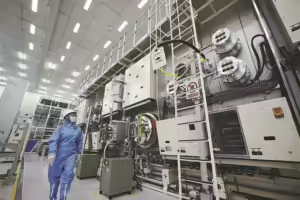
The display industry has been describing an IT OLED transition for years. In 2026, the fabs are being built. The capital is committed. The question that now matters is whether demand for OLED in notebooks, monitors, and tablets will arrive on a schedule that justifies the depreciation loads those new lines will carry well into the next decade.
Two production projects define the current moment. Samsung Display’s A6 facility in Asan, an 8.6-generation fab designed specifically for IT panels, is targeting mass production in 2026 and has drawn more display equipment spending than any single project in the current industry cycle. Omdia models A6 at approximately 15,000 8.6G substrates per month and estimates it alone accounts for roughly a third of all flat-panel equipment spending in 2024. BOE’s B16 line in Chengdu, the first 8.6G RGB fine-metal-mask OLED fab announced in China for IT applications, is modeled at 16,000 substrates per month in its initial phase, with approximately 18% higher capex than A6, attributable to a more complex LTPO backplane and module configuration.
Those are the anchors of a broader Gen-8.6 wave. China Star’s T9 Phase 2, Tianma’s TM19, and BOE’s B20 expansion are all cited as 8.6-class OLED investments targeting tablets, notebooks, and monitors. Omdia additionally assumes Visionox and Japan Display will enter the Gen-8.6 tier with their own lines based on fine-photomask patterning. Counterpoint Research projects OLED will capture approximately 67% of display equipment spending between 2023 and 2030, with LCD falling toward 30%. That capital allocation is only defensible if IT OLED becomes a genuine volume business, not a premium accessory.
Panel makers are converging on a three-lever cost structure for IT OLED, and the logic of each lever is straightforward.
The first is glass size. Transitioning IT production from Gen-6 substrates, the node that built the smartphone OLED industry, to Gen-8 and 8.6 allows manufacturers to lay out far more mid-size panels per motherglass sheet. Korean and Chinese industry analysis indicates 8.6G substrates are roughly 2.25 times the area of Gen-6. Multiple models project a 30-plus-percent cost reduction for notebook panels once Gen-8.6 yields mature. Without that area economics, no amount of materials or optical optimization gets OLED close enough to IPS LCD on price for mainstream PC designs.
The second is stack simplification. IT OLED technology reports indicate a clear intent to use single-stack OLED structures wherever possible in PC and monitor applications, reserving tandem stacks for segments where extra brightness or extended lifetime justify the added materials and process complexity. Single-stack designs reduce organic material consumption, drive circuit complexity, and the number of process steps, all of which matter when amortizing the capital cost of new 8.6G tooling in both Korea and China.
The third lever is optics, and here two distinct approaches are taking shape. The first, COE (color-on-encapsulation), integrates the color filter function directly into the OLED’s encapsulation layer, eliminating the conventional color-filter substrate and external polarizer. Samsung’s ECo2OLED smartphone implementation is the most commercially visible example. Industry estimates suggest COE-style designs deliver approximately 25 to 30% power savings versus polarizer-based OLED, while also reducing panel thickness and trimming recurring bill-of-materials cost. The second approach, variously described as pol-less or low-reflectance structures, removes the conventional color-filter and black-matrix stack along with the polarizer and replaces them with a single overcoat film tuned for reflection management and color control. The power gain is modeled at closer to 15% versus conventional OLED, a smaller improvement than COE, but the process and materials are significantly simpler and less expensive to qualify at scale.
Together with Gen-8.6 substrate scaling and stack simplification, these optical schemes are intended to bring IT-class OLED panels into a cost and power envelope that PC OEMs can justify beyond flagship and creative-professional SKUs.
The LCD narrative in 2026 is not about investment. It is about utilization management.
Omdia’s latest utilization update indicates panel makers now expect combined fab utilization to reach roughly 82% in Q1 2026, up from 81% in Q4 2025 and above initial plans for the quarter. Manufacturers had entered Q1 expecting to moderate output given typical post-holiday seasonality and uncertainty around set-maker production schedules. They revised plans upward in January and February on stronger-than-expected orders for large LCD TV and monitor panels, driven by tariff-related pre-buying into the U.S. market, precautionary component stocking, and TV brand inventory builds ahead of China’s Labor Day and 618 sales events and the World Cup broadcast cycle.
That demand strength appears tactical rather than structural. The same forecast projects panel demand easing after mid-Q2 2026, with utilization expected to slip back below 80% in May as those specific demand catalysts pass. In parallel, Omdia’s February 2026 depreciation analysis notes that many legacy LCD Gen-10.5 fabs will be largely depreciated by 2028, allowing manufacturers to run them at lower utilization rates while remaining profitable, even as new Gen-8.6 OLED fabs carry substantially heavier depreciation through the 2030s. The net effect: LCD is being run as a controlled commodity, with supply and utilization adjusted to protect pricing, while growth capital flows into IT-oriented OLED.
Demand Structure: Smartphones Underwrite the Bet
On the demand side, smartphones remain the load-bearing foundation of the OLED industry, and IT is beginning to move beyond proof-of-concept without yet carrying its own weight.
OLED monitor panel shipments reached approximately 3.2 million units in 2025, up more than 60% year-on-year, according to industry data based on UBI Research figures. Samsung Display repurposed a portion of QD-OLED TV capacity for gaming monitors, and LG Display ramped WOLED monitor output from roughly 100,000 to 400,000 units over a two-year period. TV-class OLED technologies are now being extended into 27 to 49-inch gaming monitors and are being prepared for productivity monitors and laptops, contingent on hitting OEM cost and power targets.
In notebooks, OLED still represents a small share of total shipments, but the growth rate is significant enough to validate the direction. The industry assumption is that once Gen-8.6 IT lines reach volume and the new optical stacks are qualified, OLED should be capable of moving from its current niche in gaming and creative professional notebooks into the broader premium band where IPS LCD dominates today.
Smartphones remain the anchor. Apple has been the largest single OLED smartphone buyer for several years, sourcing hundreds of millions of panels annually, which sustains utilization on existing Gen-6 fabs and gives panel makers the financial confidence to invest ahead of IT demand curves. The strategic logic the industry is operating on is explicit: smartphones keep the existing fabs full; IT is intended to pay back the new ones.
The IT OLED story in 2026 is no longer primarily about whether the industry will make the investment. It has. Gen-8.6 IT fabs in Korea and China dominate current equipment spending, and the capital allocation projections for the decade are lopsided in OLED’s favor. The open question is execution on both the supply side and the demand side simultaneously.
On the supply side, new Gen-8.6 RGB OLED factories will carry depreciation-heavy cost structures past 2030, unlike older LCD and smartphone OLED lines that begin to age out later this decade. COE and pol-less optical stacks, single-stack OLED structures, and Gen-8.6 area scaling need to work as modeled in production, not just in pilot qualification. Any yield or reflectivity issue that arrives at scale, after OEMs have committed notebook designs, delays the payback timeline with costs that compound.
On the demand side, notebook and monitor OEMs will evaluate every COE and pol-less implementation against entrenched IPS LCD on reflectivity in ambient light, color accuracy, panel lifetime under sustained productivity loads, and power consumption in bright use cases, not the selective scenarios where OLED excels most easily. Those are the conditions under which mainstream business notebook buyers, not gaming enthusiasts or creative professionals, make their decisions.
Investor and analyst commentary around OLED materials suppliers captures the tension accurately. Research on Universal Display acknowledges IT OLED and Gen-8.6 capacity as key long-term growth drivers while simultaneously flagging uncertainty about the pace of IT adoption and the timing of new emitter-material wins as reasons for cautious near-term expectations. That is a reasonable framing for the current moment: the structural argument is intact, the execution variables are real.
The direction of travel in the display industry is no longer debated at the capital allocation level. The fabs are being built. How quickly the IT demand side responds, and whether COE and pol-less stacks perform as modeled in production at Gen-8.6 scale, will be the central display industry storyline as A6, B16, and their peers move from equipment installs to actual panel shipments and OEMs decide how far down their product lines they are willing to take OLED.
| Facility | Company | Location | Capacity (substrates/mo) | Notes |
| A6 | Samsung Display | Asan, Korea | ~15,000 | Mass prod. target 2026; ~1/3 of global FPD equipment spend in 2024 |
| B16 | BOE | Chengdu, China | ~16,000 | First 8.6G RGB FMM OLED in China; ~18% higher capex than A6 (LTPO) |
| T9 Ph2 | China Star | Shenzhen, China | TBD | 8.6G-class; IT focus |
| TM19 | Tianma | China | TBD | 8.6G-class; tablets and notebooks |
| B20 | BOE | China | TBD | 8.6G expansion; IT and monitors |