
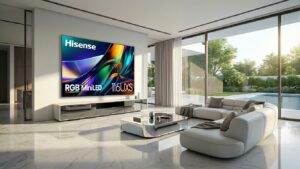
Hisense arrived at CES 2026 with a coherent thesis: more primaries mean better color. The company is applying this logic across three product categories, RGB MiniLED televisions, a new four-primary MicroLED architecture, and expanded TriChroma laser projection, creating what amounts to a unified multi-primary color ecosystem spanning 55 inches to 163 inches.
Whether consumers will notice the difference between three-primary and four-primary backlights in a Best Buy showroom is debatable. But Hisense is clearly betting that the technical story sells, particularly against OLED competitors that can’t match MiniLED brightness in sunlit living rooms.
The baseline of Hisense’s 2026 TV lineup is true RGB MiniLED with backlights using discrete red, green, and blue LEDs within each local dimming zone rather than blue LEDs with quantum dot conversion. The approach promises wider native color gamut and more precise zone-level color control.
The UR9 and UR8 series bring RGB MiniLED to screen sizes ranging from 55 to 100 inches, with thousands of local dimming zones and multi-thousand-nit peak brightness. The 116UX and 116UXS push the format to 116-inch flagship territory.
Hisense is positioning these panels as bright-room alternatives to OLED with competitive color accuracy and contrast without burn-in risk, plus substantially higher sustained brightness for HDR content in ambient light. The pitch isn’t subtle: these are displays designed for real living rooms with windows, not dedicated home theaters with blackout curtains.
The more interesting technical development is RGB MiniLED evo, which adds a fourth cyan LED to the backlight module. Hisense claims this pushes color coverage to 110% of BT.2020, beyond the theoretical limits of standard three-primary RGB, with particular improvements in sky blues and cyan tones where conventional backlights can clip or desaturate.
The first implementation is the 116-inch 116UXS, paired with the Hi-View AI Engine RGB processor for what Hisense describes as 134-bit-level color and brightness control at the zone level. The bit-depth claim warrants some skepticism, 134-bit processing is a marketing number, not a signal path specification, but the underlying four-primary architecture is technically sound.
Adding cyan addresses a real limitation. The BT.2020 color space includes cyan hues that fall outside the triangle formed by conventional red, green, and blue primaries. A fourth primary expands the achievable gamut, at least in theory. Whether source content actually contains colors that benefit from this expanded gamut is a separate question, most mastered content targets DCI-P3 or Rec. 709, not the outer reaches of BT.2020.
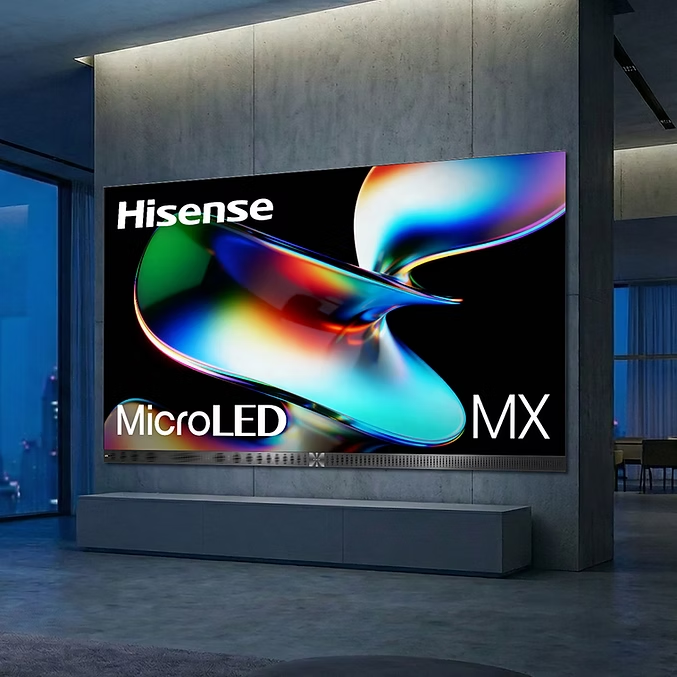
Hisense is applying the same multi-primary philosophy to MicroLED with its RGBY architecture, which adds yellow as a fourth subpixel color. The launch product is the 163MX, a 163-inch wall-class display using self-emissive MicroLED panels.
The company claims 100% BT.2020 coverage, improved viewing angles, and better color stability at high brightness levels. The Hi-View AI Engine RGB handles content-aware tone mapping and color control.
Adding yellow to MicroLED serves a different purpose than adding cyan to MiniLED backlights. Yellow improves luminance efficiency, the human eye is most sensitive to yellow-green wavelengths—and can help maintain color accuracy at extreme brightness and wide viewing angles. Whether consumers shopping for 163-inch displays (a small cohort) will appreciate the distinction is another matter.
The 163MX represents Hisense’s second generation in consumer MicroLED after last year’s 136MX debut. The company appears committed to the technology even as the addressable market for six-figure displays remains limited.
Hisense ties the television and MicroLED story together with its TriChroma ultra-short-throw laser projectors, which use discrete red, green, and blue laser light sources rather than single-laser systems with phosphor conversion. The 2026 models promise brighter output and wider color gamut for large-screen projection.
The ecosystem framing is deliberate: whether a customer wants a 55-inch bedroom TV, a 116-inch living room centerpiece, a 163-inch dedicated theater wall, or a 100-inch-plus projected image, Hisense is positioning itself as the multi-primary color company across all formats.
The Strategic Picture
Hisense’s CES 2026 message is consistent and technically grounded, even if some of the marketing claims (134-bit processing, 110% BT.2020) require careful parsing. The company is differentiating on color science at a time when competitors are primarily racing on brightness and zone counts.
The multi-primary approach does address real limitations in conventional display architectures. Whether it addresses limitations that consumers actually perceive in real content viewing is less certain. Most streaming content, broadcast television, and even UHD Blu-rays are mastered for color spaces well inside BT.2020. The expanded gamut matters most for synthetic test patterns and the occasional nature documentary with particularly vivid peacock feathers.
Still, Hisense deserves credit for a coherent technology story that spans its entire display portfolio. The company isn’t just announcing products; it’s announcing a point of view about where display technology should go. That’s a more interesting position than “our zone count is bigger than theirs.”