
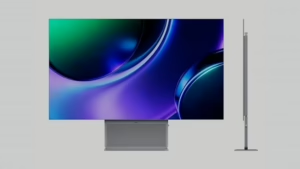
The premium monitor segment has rarely moved this fast. In the span of roughly ten days, Apple launched two new displays, TCL unveiled its first OLED monitor alongside a prototype pushing refresh rates past 1,000 Hz, and Samsung Display’s new V-Stripe QD-OLED panel began shipping to seven brands. Three very different companies, three very different strategies, and a market that is simultaneously getting more capable and more fragmented by geography, ecosystem, and use case.
Apple: Controlling the Vertical
Apple’s March 3 announcement was structurally tidy and strategically revealing. The company released two monitors under a consolidated family name: the updated Studio Display at $1,599, and the all-new Studio Display XDR at $3,299, with the latter effectively retiring the long-running Pro Display XDR.
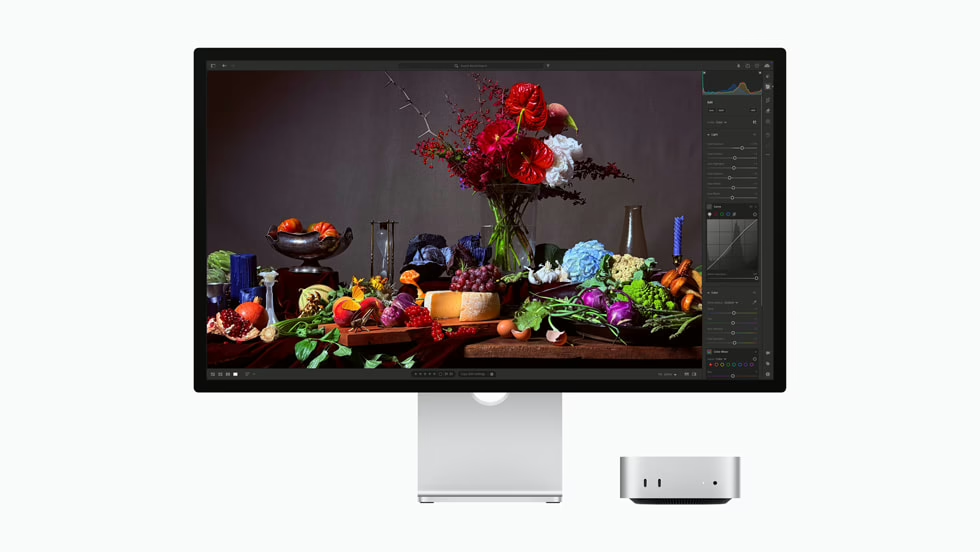
The standard Studio Display is, by most accounts, a modest refresh. The panel itself is unchanged, a 27-inch 5K IPS at 60 Hz with 600 nits peak brightness, and the chassis is visually identical to the 2022 original. The meaningful upgrades are peripheral: a 12-megapixel Center Stage camera with Desk View support, an A19 chip replacing the A13 Bionic, 8 GB of RAM (up from an estimated 4 GB), improved bass response from the six-speaker system, and dual Thunderbolt 5 ports allowing daisy-chaining of up to four additional displays. That the $1,599 price held from 2022 is notable, given four years of inflation, and reflects Apple’s calculation that the Studio Display’s value sits primarily in macOS integration and ecosystem fit, not panel advancement.
The Studio Display XDR is a different proposition. Its 27-inch panel is backlit by a mini-LED array with 2,304 local dimming zones, drives 2,000 nits peak HDR brightness, runs at 120 Hz with Adaptive Sync (47 to 120 Hz), and covers both P3 and Adobe RGB. DICOM calibration presets and a medical imaging reference mode are included, as are the same camera and audio improvements as the base model. An A19 Pro chip and 12 GB of RAM power the display processing. At $3,299 with a tilt-and-height-adjustable stand already included, the XDR lands at a lower price than the Pro Display XDR it replaces, though it is also smaller: 27 inches versus 32.
What Apple is not doing is equally instructive. There is no OLED. No 4K. No 32-inch option. No variable refresh below 47 Hz. Apple is staying inside a 5K, 27-inch, IPS-or-mini-LED framework that it has clearly decided is the right anchor for macOS workflows, and it is pricing that framework at a level that presumes the buyer is already invested in Apple Silicon. The XDR is, by any objective panel specification at the $3,299 price, an expensive proposition relative to what the non-Apple OLED market now offers. That may not matter to its target buyer.
Creator-First: High-End Monitors
| Model | Strengths for creators | Key drawbacks | Value view |
|---|---|---|---|
| Apple Studio Display (2026) | 27-inch 5K IPS, sharp text for macOS, good factory calibration, improved speakers and camera, dual Thunderbolt 5 ports for daisy-chaining | 60 Hz, no real HDR (600-nit peak), IPS glow, weak on panel-per-dollar versus OLED and mini-LED competition at similar price | Excellent integrated Mac experience if HDR and high refresh rate are not priorities; hard to justify on pure panel specs alone |
| Apple Studio Display XDR | True HDR with 2,000-nit peak and 2,304-zone mini-LED, 5K at 120 Hz, P3 and Adobe RGB, DICOM medical imaging presets, stand included | $3,299 for a 27-inch LCD; still carries haloing risk; no OLED-class blacks; locked to Apple Silicon Macs | Strong if budget is secondary to Apple-native color and HDR workflow integration; poor value versus 32-inch 4K OLEDs on raw image quality |
| TCL 32X3A OLED+ | 32-inch 4K at 240 Hz, 1,300-nit HDR, 99% DCI-P3, very thin 6.4 mm chassis, USB-C 90W PD, B&O audio | Likely LG Display WOLED panel despite “OLED+” branding; RGBW sub-pixel layout means text clarity is improved but not fully resolved; burn-in caution for static UI; China-only for now | Compelling spec-per-dollar for 4K/240 Hz HDR covering both editing and gaming at ~$870; international pricing and availability unconfirmed |
| TCL 27C3A Pro Mini-LED | 27-inch 4K, 2,304-zone mini-LED, 2,200-nit peak XDR brightness, Dolby Vision, factory Delta E < 1 calibration, 165/320 Hz dual-mode | VA-type “Fast HVA” panel: potential viewing-angle and black-level limitations versus OLED; 165 Hz ceiling may disappoint gaming-oriented buyers | Exceptional HDR output and calibration accuracy at approximately 3,199 yuan (~$463); strong choice where OLED burn-in is a concern and peak brightness matters |
One detail from TFTCentral is worth flagging: the 2,304 dimming zones in Apple’s Studio Display XDR matches the exact count in TCL’s own 27C3A Pro mini-LED monitor, which launched concurrently at approximately 3,199 yuan, suggesting a potential panel supply relationship between the two companies, though neither has confirmed this.
Samsung Display: The Text Problem Gets Fixed
Samsung Display’s most consequential announcement of the early year came not from a consumer product but from a panel press release dated January 1, 2026. The company confirmed mass production of a 34-inch 21:9 QD-OLED panel at 360 Hz, with a peak brightness of 1,300 nits, a 0.03 ms response time, and 99% DCI-P3 coverage. The production announcement itself was expected. The pixel architecture change was not.
QD-OLED’s persistent weakness in the monitor segment has been text rendering. The triangular RGB sub-pixel arrangement used in prior QD-OLED generations causes color fringing at high-contrast edges, making fine text visibly softer or fringed on desktop UIs compared to LCD. Samsung’s new panel adopts what it calls V-Stripe, a vertical RGB sub-pixel layout that aligns with the rendering assumptions baked into Windows’ font engine. The result, according to Samsung Display, is substantially better text clarity, moving QD-OLED meaningfully closer to LCD-quality desktop legibility while retaining the contrast and color volume advantages that define the technology.
Samsung Display has been supplying the V-Stripe panels to seven monitor manufacturers since December 2025, including ASUS, MSI, and Gigabyte, for monitors that began appearing publicly around CES. The ultrawide 21:9 format at 360 Hz positions this panel at the intersection of esports and creative work, and the V-Stripe improvement makes that dual-market pitch more credible than previous QD-OLED generations could support. The 360 Hz refresh rate is a step up from the 240 Hz ceiling that defined the prior generation of QD-OLED monitor panels.
According to Omdia data cited by Samsung Display, self-emissive panels now represent an estimated 23% of the premium monitor segment above $500 in 2025, rising toward 27% in 2026. Samsung claims approximately 75% of the monitor OLED panel market by shipment volume in 2025, at 2.5 million units.
TCL: Price Compression from Below
TCL’s monitor launch event in early March introduced two products that define the Chinese industry’s current approach: push specifications well above prevailing price expectations, worry about global distribution later.
The 32X3A is TCL’s first X-series monitor and its first OLED display product. The panel is a 31.5-inch unit marketed as “OLED+” through a combination of a multi-layer OLED light source and proprietary image processing. In practice, available evidence from TFTCentral and others suggests the underlying panel is an LG Display WOLED with a vertically oriented RGBW sub-pixel layout, not a new OLED category, though TCL disputes any such characterization. TCL claims the arrangement improves text clarity compared to older WOLED panels with triangular layouts, an incremental rather than transformational improvement. Peak brightness is rated at 1,300 nits, DCI-P3 coverage at 99%, response time at 0.03 ms G2G. The display supports 4K at 240 Hz natively and drops to 1080p for a 480 Hz dual-mode option. The chassis is 6.4 mm at its thinnest, an industrial design statement more than a practical specification. Bang & Olufsen-tuned speakers are integrated into the stand. HDMI 2.1, DisplayPort 2.1, and USB-C with 90W power delivery are included.
The price is 5,999 yuan, approximately $870, available in China as of March 2026. International availability has not been confirmed. At that price point, the 32X3A undercuts every comparable OLED monitor from LG, Samsung-branded sets, and ASUS by a meaningful margin, while meeting or exceeding them on key specifications. The competitive implication is clear even if the product is currently China-only.
TCL’s second announcement, the 27P2A Ultra, is more prototype than product. The 27-inch mini-LED unit runs at 550 Hz natively, with a dual-mode that reaches 1,040 Hz at 720p. TCL refers to the backlight as a High Shoot panel from its display manufacturing arm TCL CSOT, with strobing support it calls Tmoc Super Dynamic Sharpness. Dimming zone count and HDR specification were not disclosed, which limits how seriously to take the headline number, though the existence of a production-intent 1,040 Hz mini-LED panel is itself a data point about where the refresh rate race is heading. A separate 27-inch 4K 165 Hz mini-LED model with 2,304 zones and 2,200-nit peak brightness was priced at 3,199 yuan, roughly $440, a figure that further illustrates the distance between Chinese domestic pricing and premium Western retail.
The Market Shape This Creates
The divergence between these three trajectories is not temporary. It reflects structural differences in what each company is optimizing for.
Apple is optimizing for ecosystem integration and average selling price stability. Its monitors are not competing on panel specifications at the premium tier; they are competing on the value of being purpose-built for macOS, including features like Center Stage, Spatial Audio, DICOM reference modes for medical professionals, and Thunderbolt 5 daisy-chaining. The decision to hold the $1,599 base price while not improving the panel is a statement that Apple does not believe it needs to, and thus far the addressable market for Apple-silicon desktop users has not required it to. Whether that holds as more 5K 120 Hz panels enter the market from other manufacturers is a reasonable question for 2026 and 2027.
Gaming-First (with Creator Crossover)
| Model | Gaming strengths | Creator implications | Value view |
|---|---|---|---|
| 34-inch 360 Hz QD-OLED (Samsung panel, multiple brands) | 3440×1440 at 360 Hz, 1,300-nit peak, near-instant 0.03 ms response, esports-class smoothness, VRR | New V-Stripe sub-pixel layout significantly improves text clarity over prior QD-OLED generations; ultrawide format suits video and timeline work; 3440×1440 is lower pixel density than 4K at similar sizes | Strong all-round premium option; priced above 32-inch 4K OLEDs on a creator-value basis, but ultrawide and 360 Hz justify the premium for players who also edit |
| TCL 32X3A OLED+ | 4K at 240 Hz native plus 480 Hz at 1080p dual-mode, 0.03 ms response, VRR, HDMI 2.1 and DP 2.1, AMD FreeSync Premium and G-Sync Compatible | 4K resolution and wide gamut make it capable for photo and video editing; burn-in discipline needed for long static-UI sessions | Potentially one of the strongest “one monitor for everything” value plays in the market if global pricing tracks China’s ~$870 launch price |
| TCL 27P2A Ultra Mini-LED (proto) | 27-inch 1440p at 550 Hz native, 1,040 Hz at 720p dual-mode, CSOT High Shoot panel with backlight strobing | Fine for general content consumption; zone count and HDR spec undisclosed, making it unsuitable for serious HDR grading or color-critical work | Technology demonstration today; mass-market pricing unknown; shows LCD fighting back on refresh rate while ceding absolute image quality to OLED |
Samsung Display is optimizing for panel leadership in an OLED monitor market it currently dominates by volume. The V-Stripe improvement addresses the last significant structural criticism of QD-OLED in desktop applications. Combined with 360 Hz and 1,300-nit peak brightness, the new 34-inch panel extends QD-OLED’s claim on the premium gaming ultrawide segment for another year, and the seven-brand distribution approach ensures broad retail presence.
TCL is optimizing for specification-per-dollar disruption, a strategy its television division executed successfully against established Korean brands over the past decade. The 32X3A follows that playbook. If and when TCL brings the 32X3A to global markets at or near its current Chinese price, it will directly pressure the $1,100 to $1,400 pricing tier where most branded 32-inch OLED monitors currently sit. The risk to that scenario is certification, calibration credibility, and after-sales support infrastructure outside China, areas where TCL monitors have historically lagged LG and Samsung-branded products.
Where Prices Are Going
The clearest trend in the data is price compression at every tier except Apple’s. OLED at 4K and 240 Hz, which cost more than $1,500 at retail as recently as eighteen months ago, is now broadly available in the $800 to $1,200 range across LG, ASUS, MSI, and comparable brands. TCL’s entry at $870 for a well-specified 32-inch OLED threatens to pull that floor lower. Mini-LED at high zone counts is following a similar trajectory, with Chinese domestic pricing suggesting eventual global retail well below current Western market norms.
Apple is the outlier, holding price while others compress. That is sustainable as long as macOS integration carries premium value that users will pay for. The Studio Display XDR at $3,299 is a reference monitor with a medical imaging preset and an Adobe RGB profile on a 5K 120 Hz mini-LED panel, and it competes on those terms. The standard Studio Display at $1,599 for a 60 Hz IPS has fewer obvious peers, but “obvious” may be the operative word as the market fills in around it.
The broader picture entering mid-2026 is a premium monitor market that has effectively split into three tiers with different competitive dynamics: the Apple ecosystem tier, where integration and ASP are stable; the Korean-brand and global-OEM OLED tier, where QD-OLED and WOLED compete intensely on specification at declining prices; and the emerging Chinese OLED and ultra-high-Hz mini-LED tier, which is moving rapidly in specification and even more rapidly in pricing, but remains geographically constrained for now.
That last tier is the one to watch.