
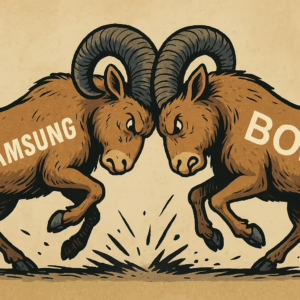
Apple has redirected millions of iPhone OLED panel orders from BOE to Samsung Display following persistent yield issues at BOE’s Mianyang fab. The reallocation, spanning December 2025 and January 2026, covers multiple iPhone generations and further entrenches Samsung Display’s position as Apple’s indispensable OLED partner while confining BOE’s near-term growth prospects to lower-tier LTPS panels for entry-level devices.
BOE’s B11 AMOLED fabrication facility in Mianyang began experiencing process-related defects around November–December 2025, forcing suspension or sharp reduction of iPhone OLED output across multiple models. The issues affect both LTPS OLED panels destined for iPhone 15 and 16 as well as more complex LTPO panels for iPhone 17, a breadth of impact that surprised industry observers given BOE’s previously stable LTPS shipment history with Apple.
Before the defects emerged, BOE had been building momentum in Apple’s supply chain. The B11 line was reportedly operating at roughly 70% utilization with annual capacity estimated in the tens of millions of 6.1-inch panel equivalents. The current disruption represents a significant setback to that trajectory.
To protect iPhone production schedules, Apple has shifted orders for millions of panels to Samsung Display, which deployed spare capacity to absorb the volume quickly. Reports collated from The Elec and other Korean industry sources describe a broad reallocation: Samsung is now covering iPhone 15, 16, 17, and 16e models that BOE was originally slated to supply.
The rescue operation reinforces Samsung’s role as Apple’s de facto safety net for OLED procurement. Shipment and forecast data indicate Samsung Display already dominates Apple’s OLED sourcing, supplying on the order of 120–125 million smartphone OLED panels annually, materially higher volumes than LG Display and BOE combined. The BOE diversion further entrenches that lead.
Despite the setback, BOE retains a meaningful role in Apple’s supply chain—albeit confined to cost-sensitive segments. The Chinese panel maker remains Apple’s primary OLED supplier for the upcoming iPhone 17e, which reuses iPhone 14-class LTPS OLED specifications with thinner bezels. Industry reports indicate BOE holds the largest allocation for that entry-tier model, with Samsung Display and LG Display sharing the remainder.
The lifeline is strategically limited. Repeated yield problems and a two-month production disruption have damaged BOE’s credibility precisely as the company was attempting to expand beyond LTPS into higher-value LTPO and next-generation panel tiers for Apple. For now, BOE appears largely confined to entry devices and China-focused iPhone variants where cost optimization takes precedence over yield risk management.
Beyond current iPhone models, Samsung Display is positioned as Apple’s exclusive or primary supplier for advanced and high-risk form factors. Industry reports point to Samsung as the OLED partner for Apple’s first foldable iPhone, with planned volumes around 10–11 million foldable panels in 2026. The allocation reflects Apple’s confidence in Samsung’s process maturity for novel display architectures where yield variability poses the greatest production risk.
The BOE disruption crystallizes Apple’s dual-track OLED procurement strategy. BOE serves as a cost lever and secondary source on entry devices like the iPhone 17e, providing competitive pricing pressure and supply chain diversification at the lower end of the portfolio. Samsung Display, and to a lesser extent LG Display, functions as the core supplier for premium, high-specification, and new-form-factor OLEDs where yield consistency and technology execution are paramount.
For BOE, the path to higher-value Apple business now runs through an extended credibility rehabilitation. The company must demonstrate sustained yield stability on current LTPS allocations before Apple will entrust it with the LTPO and advanced panels that carry higher margins and strategic importance. That timeline, already measured in years before the Mianyang crisis, has likely extended further.