
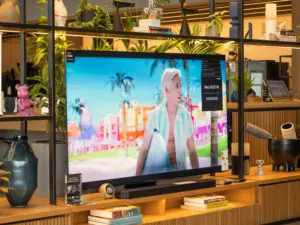
When LG Display confirmed at the end of January 2026 that it has halted production of all 8K TV panels, OLED and LCD alike, and put further development on hold for the foreseeable future, the announcement landed less as a shock and more as a death certificate for a patient that had been on life support since at least 2023. LG’s last 8K OLED, the Z3, had been carried over for two consecutive model years before being quietly discontinued. Its 8K QNED LCD line will not be renewed. The 2026 TV range is anchored entirely on 4K OLED and 4K MiniLED, with AI-driven processing positioned as the new premium differentiator.
With LG gone, Samsung is the only major manufacturer still actively developing and shipping fresh 8K TV models. Panasonic maintains a limited 8K presence in select markets, but no one would call that an ecosystem. The trajectory now looks unmistakably like 3D TV’s: a strong push on a spec as the next premium hook, followed by a quiet retreat once content, bandwidth, and human-factors realities set in.
The 8K story began with genuine optimism. Around 2018–2019, Samsung, LG, and Sony positioned 8K as the natural successor to 4K, and IHS Markit forecast shipments climbing from roughly 338,000 units in 2019 to 3.7 million by 2021. The 8K Association, led by Samsung, grew to more than 30 members spanning TV brands, panel makers, and content partners. Early flagships—Samsung’s Q900 series, LG’s Z-series OLEDs, Sony’s Z9 line—were pitched as the pinnacle of large-screen picture quality.
Those shipment targets were never met. The 3.7 million figure assumed an ecosystem that would develop in parallel: native 8K content on streaming platforms, 8K broadcast pipelines, and consumer willingness to pay a steep premium for pixels they could barely distinguish from 4K at normal viewing distances. None of it materialized at scale. By 2023, consumers had settled comfortably into 4K HDR on 65–85 inch sets, content pipelines remained stubbornly 4K-first, and the viewing-distance math made the extra resolution invisible on anything short of a 100-inch screen viewed from six feet away.
The exit was not sudden. It unfolded in stages across three years, each departure reinforcing the next.
TCL stopped releasing new 8K models after its 2021 line and confirmed in 2023 that it had no further 8K TV products planned, redirecting its premium resources into 4K MiniLED and QLED. Sony’s last 8K TV, the Bravia Z9K, carried over into 2023–2024 and was discontinued with no 8K successor in the 2025 range; Sony’s entire 2025 TV lineup is 4K, spanning QD-OLED and MiniLED. Notably, Sony continues to use 8K cameras and workflows in professional production, a reminder that the resolution has value in acquisition even when it doesn’t in delivery.
The 8K Association itself became a leading indicator of collapse. Hisense, TCL, Changhong, and TPV all withdrew. On the panel-supply side, Samsung Display, BOE, Innolux, and CSOT departed, leaving AUO as the only remaining panel member and Samsung plus Panasonic as the only TV brands still in the consortium. Content and technology partners, Amazon, Tencent, Harmonic, and others, dropped out as well. By late 2025, a Chosun Biz report described 8K TVs as “disappearing from the market” and Samsung Electronics as effectively alone in the segment.
LG’s January 2026 confirmation was the final domino. A spokesperson told reporters that the company is technically ready to resume 8K panel production if conditions improve, but the language of the statement, monitoring “market and content-ecosystem trends,” reads less like a strategic hedge and more like a polite way of saying: call us when Netflix starts streaming in 8K.
The Streaming Wall That 8K Never Climbed
That Netflix reference is not rhetorical. The major streamers have effectively decided that 4K HDR is the ceiling for consumer image quality for now, and that innovation should focus on quality per bit rather than more pixels. Netflix, Prime Video and Disney+ all top out at 4K with advanced formats (Dolby Vision, HDR10+, IMAX Enhanced) and higher bitrates on premium tiers, while investing heavily in better compression (AV1, smarter encoding ladders) so they can deliver cleaner 4K within realistic bandwidth and cost envelopes, not 8K streams that would need 2–4× the data and CDN spend for marginal perceptual gains on typical living‑room screens. In practice, that means future picture upgrades are more likely to come from denser HDR metadata, wider color, improved tone‑mapping and AI‑assisted compression/upscaling, plus perhaps spatial/immersive video for headsets, rather than native 8K, which remains technically feasible but economically and practically unattractive at scale given today’s networks and device base.
Understanding why requires looking at the infrastructure economics, which are punishing at 8K scale.
A reliable 4K stream requires roughly 25 Mbps, with 50 Mbps providing comfortable headroom. An 8K stream, with four times the pixel count, starts at a minimum of 50 Mbps and realistically needs 100 Mbps or more to avoid buffering. With the older H.264 codec still prevalent in many delivery chains, 8K can demand well over 100 Mbps; even HEVC (the current workhorse) lands in the 50–60 Mbps range for acceptable quality. At the household level, 8K at least doubles the required access speed for a single stream. In a home running multiple concurrent streams, the arithmetic gets uncomfortable fast.
AV1, the codec that promises the best compression efficiency for 8K, can save 30–50 percent versus VP9 at comparable quality. But it comes with a punishing trade-off: AV1 encoding at 4K and above is dramatically more CPU-intensive than AVC or HEVC, meaning cloud or on-premises encoding farms need significantly more compute and power per minute of content to produce 8K adaptive bitrate ladders. For a service like Netflix, which encodes thousands of titles and maintains multiple quality rungs per title, adding 8K means heavier encode workflows, higher ongoing storage for larger mezzanine and distribution files, and more cache variants on the thousands of edge servers in its Open Connect CDN.
The economics sharpen further at the CDN layer. A high-quality 4K movie stream averaging 20–25 Mbps over two hours delivers roughly 18–22 GB. An 8K version at 50–60 Mbps pushes that to 45–55 GB. At typical large-operator CDN pricing of $0.02–$0.08 per GB, delivery cost per viewing roughly doubles or triples—moving from the $0.60–$1.10 range for 4K to $1.50–$2.75 for 8K, before factoring in the extra encoding and storage overhead. Scaled across hundreds of millions of monthly viewers, that uplift becomes a material hit to cost of goods sold. And the audience that would actually see the benefit, owners of 8K-capable, properly calibrated sets sitting close enough to perceive the difference, is vanishingly small.
If pre-encoded VOD at 8K is expensive, live 8K streaming is borderline impractical at consumer scale. Vendor guidance suggests encode bitrates around 100 Mbps and 150–200 Mbps of dedicated upstream per encoder. That implies not just fatter pipes but fundamentally upgraded ingest, storage, and monitoring infrastructure, plus new hardware decoders in TVs and set-top boxes. NHK’s BS8K satellite channel in Japan remains the only meaningful live 8K service in operation, and it serves a small, heavily subsidized audience.
What makes the 8K story instructive for the display industry is not simply that a technology failed to find an audience. It is that the failure exposed a structural disconnect between how TV makers and how content distributors assess the value of a new capability.
For the panel and TV OEMs, 8K was a supply-side push: a way to refresh the spec sheet, justify premium pricing, and differentiate in a market where 4K had become commoditized. The assumption was that content would follow hardware, just as it had in the transitions from SD to HD and from HD to 4K. But those earlier transitions were powered by simultaneous infrastructure investment, HD broadcast mandates and spectrum reallocation in the first case, widespread fiber and HEVC adoption plus Netflix’s aggressive 4K encoding in the second. No equivalent forcing function existed for 8K. There was no regulatory mandate, no major platform committing to 8K delivery, and no consumer revolt demanding more pixels.
Meanwhile, the streamers were making a different calculation entirely. Their investment in picture quality has gone toward HDR (Dolby Vision, HDR10+), wider color gamut, higher frame rates, and format innovations like IMAX Enhanced—all of which deliver perceptible benefits at 4K without multiplying bandwidth costs. For Netflix, Amazon, and Disney, the return on investing in better 4K far exceeds the return on enabling 8K for an audience that barely registers in their subscriber metrics.
The result was a classic chicken-and-egg stalemate, except that one side (the content side) had no economic incentive to move first, and eventually the other side ran out of patience.
What Comes Next
Samsung will continue to carry the 8K flag, though even it appears to be de-emphasizing the spec. At CES 2026, the company’s showcase was dominated by its Micro RGB TVs, QD-OLED panels, and high-end 4K MiniLED, not 8K. The 8K models remain in the lineup as a halo tier, but the marketing energy has clearly shifted.
For the broader industry, the lesson is already being absorbed. The premium TV story in 2026 and beyond is about brightness, contrast, AI-driven processing, and format support, not pixel count. LG’s own 2026 range makes the point explicitly: tandem OLED and advanced MiniLED with AI upscaling, positioned as meaningfully better than last year’s 4K, not as a stepping stone to 8K.
Could 8K return? In principle, yes. Encoding efficiency will continue to improve, broadband speeds will rise, and very large screens (100 inches and above) are growing as a category where higher resolution has genuine perceptual value. But the infrastructure gap remains vast. Until streamers see a business case for 8K delivery, or until a new class of content, perhaps immersive or spatial, creates native demand for the resolution, the format will remain what it has become: a proof of manufacturing capability rather than a consumer proposition.
LG’s exit doesn’t just mark the end of multi-vendor 8K competition. It marks the moment the display industry formally conceded that resolution, after driving two decades of upgrade cycles, has hit the ceiling of what consumers and content pipelines are willing to support. What happens above that ceiling is, for now, Samsung’s problem alone.