

Samsung is showcasing its 130-inch Micro RGB TV (model R95H) at CES 2026, the company’s largest display using its Micro RGB technology platform. Marketed as an architectural centerpiece rather than a conventional television, the R95H combines Samsung’s RGB MiniLED backlight architecture with quantum dots to claim 100% BT.2020 color gamut coverage—a specification that, if validated in independent testing, would represent a significant step beyond the DCI-P3 coverage that defines today’s premium displays.
The announcement comes as Samsung continues to refine its positioning in the ultra-large display segment, where it competes with LG Display’s expanding WOLED lineup and the promise of true self-emissive MicroLED technology that remains largely confined to commercial installations.
What Micro RGB Actually Is
Industry coverage has been quick to clarify what Samsung’s “Micro RGB” branding represents. Micro RGB uses an LCD panel with a full-array backlight composed of micrometer-scale RGB LEDs,not the self-emissive per-pixel architecture of true MicroLED displays. The technology occupies a middle ground between conventional MiniLED backlighting and genuine MicroLED.
The R95H employs a VA LCD panel paired with the RGB LED backlight and quantum dot enhancement layer. Samsung claims VDE certification for what it calls “Micro RGB Precision Color 100,” asserting full BT.2020 gamut coverage. The distinction matters: where true MicroLED would offer per-pixel emissive control comparable to OLED, Micro RGB remains fundamentally an LCD with advanced local dimming, inheriting both the brightness advantages and contrast limitations of that architecture.
Samsung has equipped the display with a dedicated “Micro RGB AI Engine Pro” alongside “Micro RGB Color Booster Pro” and “Micro RGB HDR Pro” processing systems, applying AI-driven upscaling to color, contrast, and detail. The set supports HDR10+ Advanced, the next-generation HDR10+ format debuting across Samsung’s 2026 TV lineup.
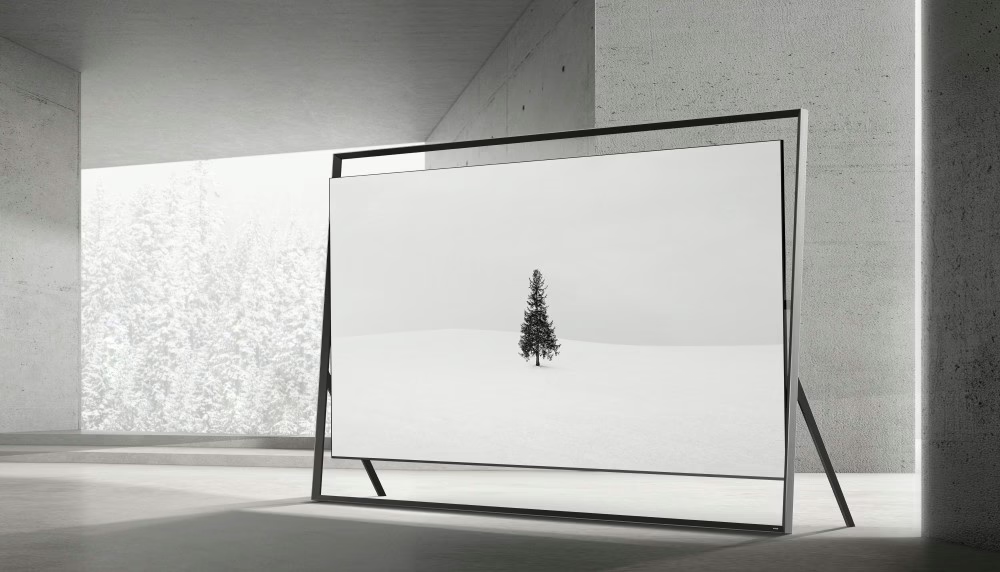
Samsung has wrapped the 130-inch panel in what it calls a “Timeless Frame” design, an evolution of the company’s 2013 “Timeless Gallery” aesthetic approach. The frame is engineered to present the display as an architectural window rather than a mounted television, with the screen appearing to float within its borders.
Audio is integrated directly into the frame structure and tuned for the 130-inch scale. Samsung also references “Eclipsa Audio,” a branded audio package paired with the HDR system, though detailed specifications remain limited.
The design strategy reflects the reality of ultra-large display installation: at 130 inches, conventional wall mounting presents significant logistical challenges, and the sculptural frame approach addresses mounting concerns while reinforcing the product’s positioning as a design statement.
Early hands-on impressions from the show floor have been largely positive regarding visual impact. The demonstration unit delivered near projector-sized imagery, vivid color reproduction, deep blacks relative to LCD norms, and MiniLED-class brightness that renders content with a “hyper-real” quality.
Viewed alongside Samsung’s 2026 flagship OLED offerings, the Micro RGB set matches or exceeds the brightness of high-end MiniLED displays while delivering larger color volume. However, OLED retains advantages in perceived black level and per-pixel contrast,limitations inherent to any backlit LCD architecture regardless of local dimming sophistication.
Samsung’s existing 115-inch Micro RGB R95H variant currently sells at approximately $30,000, and the 130-inch model is expected to command an even higher price point with limited volume availability later in 2026. The positioning places the R95H in direct competition with large-format MicroLED installations, ultra-premium MiniLED and OLED sets, and custom projection systems. Samsung’s differentiation strategy emphasizes the combination of extreme size, full BT.2020 color capability, and integrated AI features,a package aimed at luxury home theaters and design-driven showcase spaces rather than mainstream adoption.
This market segment remains challenging. The premium TV battle has intensified with MiniLED LCD gaining ground against OLED in ultra-large sizes. Samsung’s Micro RGB platform attempts to capture the brightness and size advantages of LCD technology while closing the color gamut gap that has historically favored self-emissive technologies.
AI Integration
The R95H ships with Samsung’s enhanced Vision AI Companion, enabling conversational search, proactive content recommendations, and access to AI-driven features. Voice interaction supports multiple languages including English, French, Spanish, Portuguese, German, Italian, and Korean, though recognition accuracy varies by accent and region.
Additional AI capabilities include AI Football Mode Pro, AI Sound Controller Pro, Live Translate, Generative Wallpaper, and integrations with Microsoft Copilot and Perplexity. Samsung notes that feature availability depends on region, model, remote type (Bluetooth remote often required), and connectivity,a now-standard caveat for smart TV AI features.
Samsung’s claimed specifications warrant scrutiny. The company asserts 100% BT.2020 coverage, Glare Free anti-reflection treatment, and advanced local dimming through the Micro RGB backlight architecture.
Independent validation of these claims will be critical. The display industry has seen persistent gaps between manufacturer specifications and real-world measurements. LG Display’s 4,000-nit claims for 2025 Tandem WOLED panels yielded approximately 2,200 nits in independent testing. Similar measurement gaps have appeared with Samsung’s QD-OLED specifications.
The Glare Free technology may prove particularly significant for the intended use case. At 130 inches, ambient light management becomes critical,sunlit rooms that would merely reduce contrast on a 65-inch display can fundamentally compromise the viewing experience at this scale.
The 130-inch Micro RGB R95H represents Samsung’s continued investment in the ultra-premium segment at a time when the broader display market faces headwinds from tariffs, demand uncertainty, and intensifying competition from Chinese manufacturers.
Samsung’s strategy appears focused on maintaining premium pricing power through technological differentiation and design integration, targeting buyers for whom the $30,000+ price point represents furniture-grade investment rather than electronics expense.
Whether the Micro RGB platform can establish a sustainable position between conventional MiniLED and true MicroLED remains uncertain. The technology delivers measurable improvements in color gamut and brightness, but faces the fundamental limitation that LCD backlighting,however sophisticated,cannot match the per-pixel contrast control of self-emissive displays.
For the display industry, the R95H announcement underscores a broader trend: as OLED technology continues its advance in brightness and efficiency, LCD manufacturers are pushing the architecture to its limits through innovations in backlight technology and quantum dot enhancement. The resulting competitive landscape offers consumers unprecedented choices in premium display technology, each with distinct trade-offs that marketing language often obscures.