
The automotive display market has rarely produced a quiet quarter, but the pace of MicroLED-specific announcements in early 2026 stands out even by recent standards. Where prior years delivered mostly prototype demonstrations at trade shows, several companies are now presenting platform-level products with sample availability timelines, partner co-development frameworks, and defined application targets. The common thread: MicroLED is no longer being positioned purely as a cockpit upgrade. Increasingly, suppliers are aiming it at the exterior of the vehicle, at lighting interfaces, and at surfaces, such as mirrors, that have historically been passive components.
JBD’s Griffin: Projection as a Vehicle Communication Layer
The most recent announcement, and one of the more strategically pointed, came on March 3 when Shanghai-based JBD launched Griffin, an automotive-grade MicroLED projection platform. JBD built its reputation on AR near-eye microdisplay panels, and Griffin represents a deliberate pivot of that miniaturization expertise into the vehicle domain.
The first product on the platform, Griffin I, packages hundreds of thousands of pixels into a 0.25-inch display area and delivers up to 500 lumens of luminous flux while meeting automotive reliability standards. The form factor is compact enough to mount inside rearview mirrors, doors, or other locations around the vehicle body, which is the point: JBD is not pitching this as a dashboard instrument or heads-up display in the conventional sense, but as a projection system for communicating outward from the vehicle.
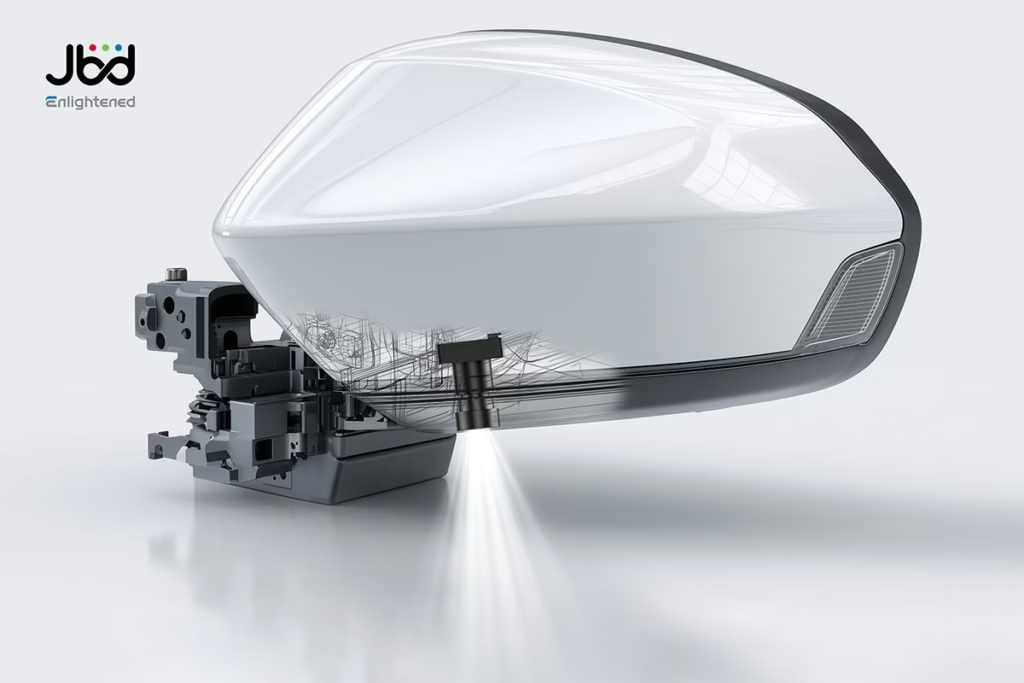
The stated application scenarios divide into three categories. First, personalized welcome functions, where ground projections show custom patterns or dynamic content when the driver approaches. Second, vehicle status indication, where battery level, tire pressure, or other health data is projected onto the ground before the driver enters. Third, road safety applications, where projection communicates vehicle intent to pedestrians and other drivers during turns or door openings. JBD describes this as a new human-vehicle interaction paradigm, and while that framing is marketing language, the underlying hardware question it addresses is concrete: exterior digital lighting today is largely constrained to flashes and color changes, and a high-brightness projection module that fits in a door panel is a meaningfully different capability.
Griffin I samples are targeted for mid-2026. JBD is signaling a co-development model with OEMs and Tier 1s rather than a direct product sale, and notes that the platform can extend beyond automotive into commercial and consumer projection applications.
VueReal: Two Bets on Exterior and Mirror Surfaces
Canada-based VueReal entered the year with two distinct automotive propositions, both announced around CES 2026 in early January. The first, TrueVue, is a MicroLED-powered smart mirror platform targeting automotive Full Display Mirror programs and consumer smart mirror applications. VueReal describes it as engineered to maintain both high mirror reflectivity and high display brightness simultaneously, which addresses a known optical trade-off that has limited the appeal of earlier display mirror technologies. The TrueVue platform is designed to deliver context-aware content, including safety prompts, navigation cues, and system status, directly on the mirror surface without thermal management requirements.
The second announcement came via a partnership with Flex-N-Gate, a major Tier 1 automotive lighting supplier, to co-develop next-generation brake-light modules using VueReal’s MicroSolid Printing platform. The demonstrator the two companies unveiled targets dynamic, context-aware signaling and more capable vehicle-to-vehicle light communication. From a supply chain standpoint, the Flex-N-Gate partnership is notable because it pairs VueReal’s component-level MicroLED manufacturing with an established lighting integrator that already works with major OEMs, suggesting a clearer commercialization path than partnerships with display makers alone would provide.
VueReal raised $40.5 million in a Series C round in early 2025, and has recently indicated it intends to license its MicroLED microdisplay IP portfolio to a single partner while concentrating internal development on automotive applications, wearables, and larger-area displays.
BOE and Innolux: HUD Brightness as a Competitive Axis
At CES 2026, BOE demonstrated a MicroLED-powered Panoramic HUD reaching 300,000 nits peak brightness, which the company pairs with AI-based voice and gesture control claiming a 98% recognition rate for complex commands. BOE also showed a touch-enabled transparent MicroLED panel on a wood-grain substrate intended for automotive interiors. Neither product carries a production timeline that has been publicly disclosed, but the HUD brightness figure is worth noting: 300,000 nits exceeds what any OLED-based HUD can practically achieve and puts direct-view MicroLED in a performance category where competing technologies simply cannot follow.
Innolux made similar bets at the same show, demonstrating three separate MicroLED automotive concepts: a transparent MicroLED Display Window, a HUD rated at 50,000 nits direct brightness and 10,000 nits reflective virtual image brightness, and a Decoration Display on wood-grain substrate offering 2,000 nits at 229 PPI and 115% NTSC color gamut. The Decoration Display targets ship cabins and car interiors, an indication that panel makers are searching for volume paths in premium interior surfaces beyond the instrument cluster.
Production Investment: LEKIN’s $735 Million Suzhou Fab
Behind the product announcements, LEKIN Semiconductor has disclosed plans for a 5.2 billion yuan ($735 million) production facility in Suzhou focused on automotive optoelectronic modules and displays. LEKIN’s stated ambition is vertical integration from LED epiwafers to finished display modules, with capacity targeted at supplying more than five million vehicles annually. A second phase of the investment will address mini-LED and MicroLED specifically. The scale of this commitment, a nine-figure capex in a single dedicated facility, reflects how seriously at least some Chinese manufacturers are treating automotive as a medium-term volume market for MicroLED, even as the technology remains largely in the prototype and sampling phase outside China.
Inside the Cabin: Large Panels Move from Option to Standard
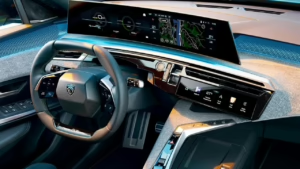
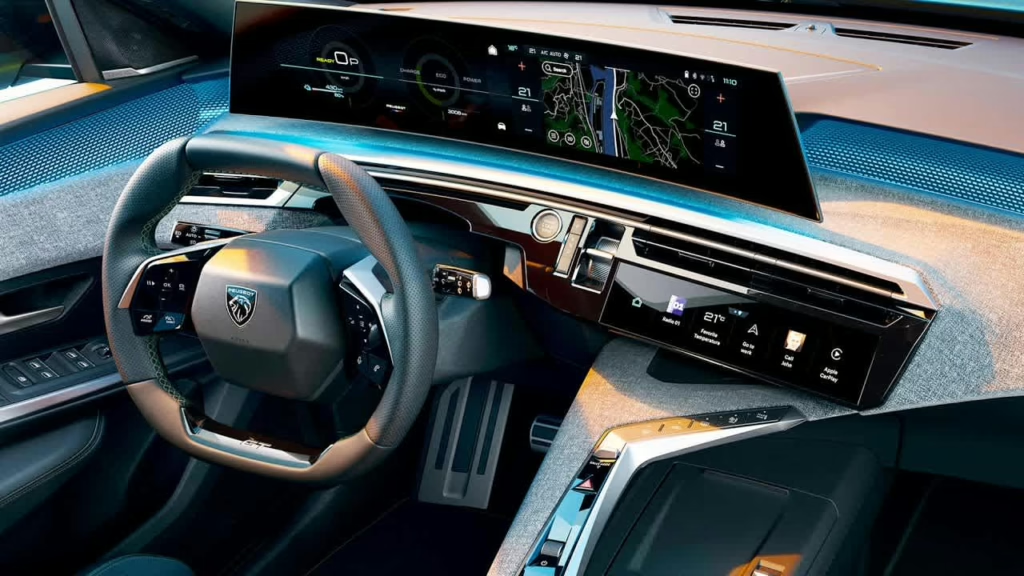
While MicroLED supplier activity has concentrated on exterior and specialty applications, automotive OEM launches in 2026 continue to push larger, unified interior displays into the mainstream. Peugeot’s E-3008 debuts a single 21-inch curved panel merging the instrument cluster and central infotainment display into one floating unit above the dash, with ambient lighting integrated beneath and an ergonomically curved geometry aimed at reducing eye movement. Mazda’s 2026 CX-5 makes a sharper break with its own history, abandoning the small non-touch layouts the brand held onto longer than most competitors, in favor of a standard 12.9-inch and optional 15.6-inch touchscreen with Google built-in integration. These are volume models in competitive segments, and their specification choices have direct implications for panel demand and mix at their respective display suppliers.
From Whether to Where
Taken together, the early 2026 announcements suggest the automotive MicroLED conversation has shifted from “whether” to “where.” The interior cockpit is already absorbing larger LCD and OLED panels at increasing rates, and the performance ceiling there, in terms of size, resolution, and integration, is well understood. The more open frontier is everything outside the passenger compartment: exterior body lighting, projection surfaces, mirrors, and HUDs that need to compete with direct sunlight. MicroLED’s combination of brightness, durability, compact packaging, and long operating life makes it a credible candidate for those applications in a way that OLED is not.
The sample availability dates and co-development frameworks being announced now, Griffin I in mid-2026, VueReal products in active partner engagement, suggest that OEM hardware evaluation cycles for these technologies are beginning in earnest. Production volumes are a different question, and the qualification timelines for automotive components are long. But the direction of supplier investment is increasingly clear.