
LG Display is showcasing its Primary RGB Tandem 2.0 technology at CES 2026, with TV panels claiming peak brightness of 4,500 nits, a figure that, if realized in shipping products, would represent a dramatic leap from where OLED stood just three years ago.
The new OLED TV panel is branded as Primary RGB Tandem 2.0. In this panel, red, green and blue OLED emitters are stacked in independent layers. In this new version, LG has utilized an even more refined pixel structure and advanced algorithms to maximize light efficiency. LG Display also says the panel incorporates advanced light-absorption and diffusion technology to minimize reflections, delivering the lowest reflection rate among existing displays of just 0.3 percent.
The company is also rebranding its OLED technology lineup. The brand name Tandem WOLED has been designated for large-sized OLED technologies used in TVs and monitors, while Tandem OLED represents small- and medium-sized RGB OLED technologies for applications such as automotive displays, tablets, and laptops.
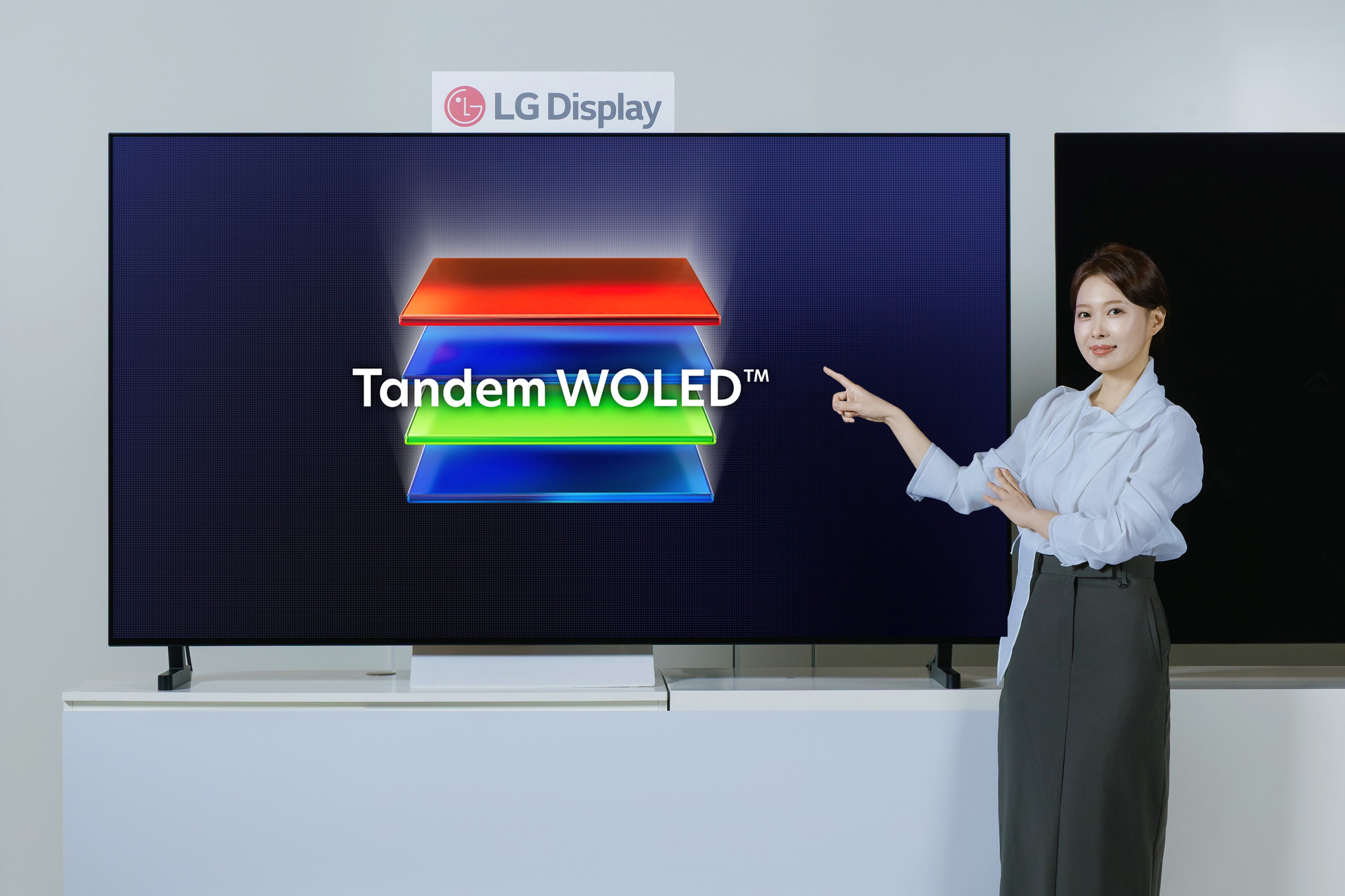
The OLED evo G6 will use LG’s new Primary RGB Tandem 2.0 display panel, which advances on the Primary RGB Tandem panel used in the LG G5. Enhancements include Hyper Radiant Color technology, which, according to LG, extends the brightness benefits of its Primary RGB Tandem panel to other picture quality factors such as color and contrast. LG’s specs for the new G6 include a Brightness Booster Ultra feature that will provide a 20% brightness increase over the G5.
For gaming monitors, the company said it will apply its upgraded Primary RGB Tandem 2.0 WOLED stack across all 2026 gaming panels, enabling up to 1,500 nits, HDR True Black 500, and 99.5% DCI color reproduction.
New panel sizes are also coming. LG Display is teasing a 27-inch UltraHD panel, an option that’s already widely available from competing Samsung Display QD-OLED panels, but which would be a first for LG Display and their WOLED technology. The company has also confirmed a curved 39-inch Tandem WOLED panel with 5120×2160 ultrawide resolution, with 1,500 nits peak brightness and True Black 500 certification.
The 4,500-nit figure warrants some context. LG Display said its 2025 Tandem WOLED panel could hit 4,000 nits peak brightness, but FlatPanelsHD measured 2,213 nits peak brightness on the LG G5. Samsung Display saw a similar gap between its claims and real-world measurements on QD-OLED. The rated figures typically reflect narrow test windows under controlled conditions rather than what viewers experience with actual content.
The path to Tandem WOLED 2.0 reflects LG Display’s pivot away from its earlier brightness strategy. At CES 2023, the company introduced META Technology, which used Micro Lens Array (MLA), a layer of billions of micrometer-sized convex lenses over the OLED emissive layer, to improve light extraction. LG claimed 60% brightness gains over conventional OLED and 22% better energy efficiency.
At CES 2024, META Technology 2.0 pushed the approach further with an optimized MLA+ lens design, hitting 3,000-nit peak brightness claims (at the time, the highest for any large-format OLED panel). Then came a strategic shift. In 2025, LG’s G-series moved away from the MLA panel in favor of LG Display’s new 4-layer WOLED structure, also known as Primary RGB Tandem or 4th generation OLED. Where previous LG OLEDs used yellow and two blue layers, the G5 dedicates separate layers to red, green, and two blue emissions.
The results were significant. FlatPanelsHD measured 2,200 nits on the G5 in calibrated mode, compared to 1,650 nits on the G4, taking the crown as the OLED TV with the highest HDR brightness. LG claims the new G5 delivers 40% higher full-screen brightness over last year’s G4 while also improving energy efficiency; the 65-inch LG G5 is rated at 164W in energy consumption, down from 209W on the 65-inch G4.
LG Display faces intensifying competition. Samsung Display is also claiming 4,500-nit panels for 2026 with its fifth-generation QD-OLED technology. Both companies have introduced RGB stripe pixel structures for monitors to address text clarity issues that plagued earlier OLED designs.
As early as 2013, LG Display successfully mass-produced the world’s first large-sized OLED TV panels, establishing the foundation for the concept of stacked emission layers. The Tandem rebrand and 2.0 technology update represent the company’s effort to maintain leadership in a market that now includes serious competition from Samsung’s QD-OLED and upcoming entries from TCL.
Automotive push
LG Display is operating a dedicated automotive display booth at the Las Vegas Convention Center, separate from its large-format OLED showcase at the Conrad Hotel. LG Display will debut an OLED-based P2P (pillar-to-pillar) display for the first time at CES 2026. Spanning from the driver’s seat to the front passenger seat, this 51-inch ultra-large display is implemented as a single panel, enabling personalized infotainment experiences for each occupant. The company says it can mass-produce automotive P2P displays using multiple technologies, including OLED, LTPS LCD, and Oxide TFT LCD.
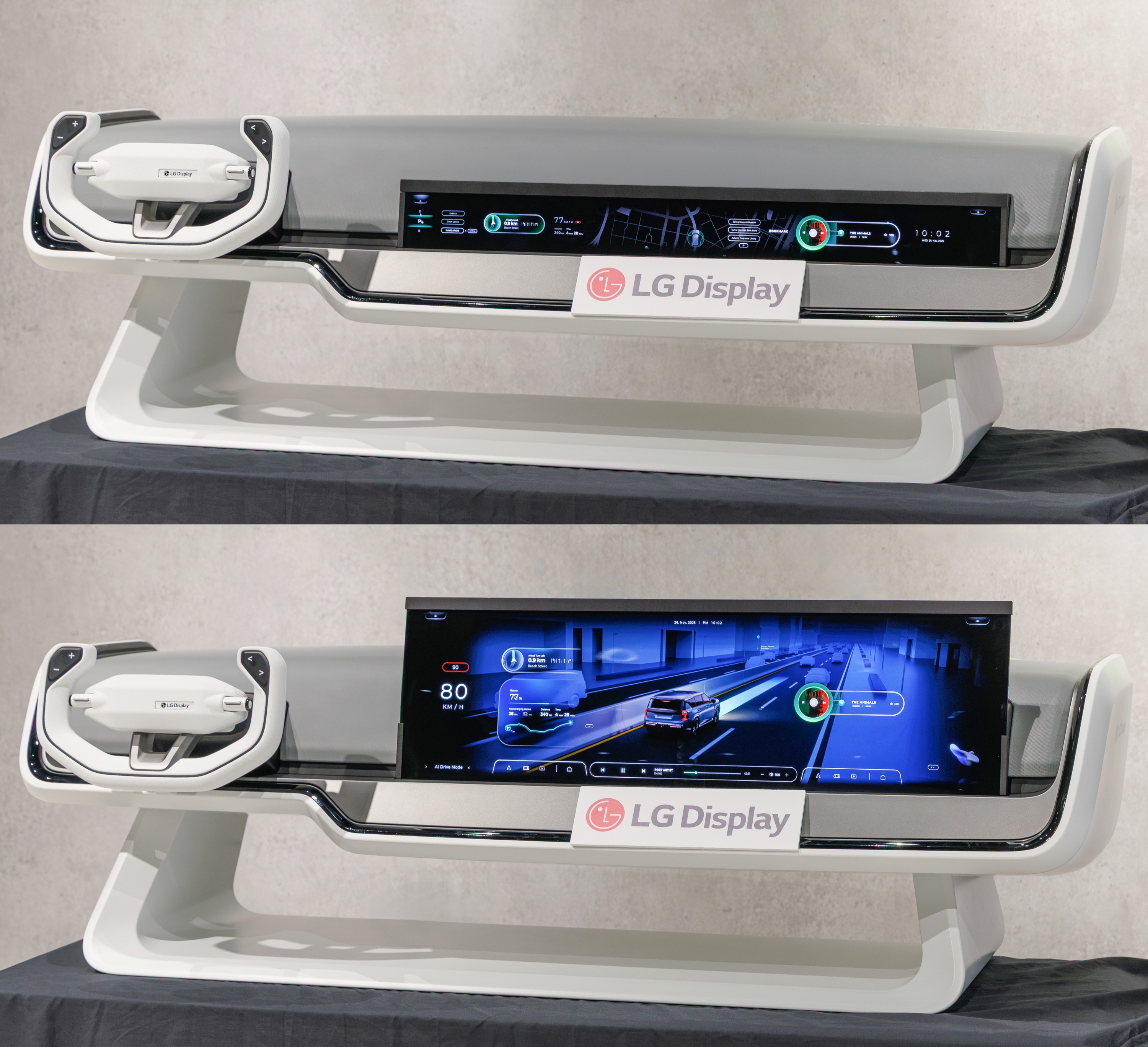
Also for the first time, the company will demonstrate a new concept that applies a Slidable OLED display to the front dashboard. Leveraging plastic OLED (P-OLED), which is thin, flexible, and offers ultra-high picture quality, part of the display can be rolled with a curvature of 30R (a circle with a 3cm radius) and hidden inside the dashboard.
The automotive focus reflects the Tandem OLED branding strategy: in 2023, LG Display mass-produced the world’s first 17-inch foldable laptop panel using a Tandem structure. This was followed in 2024 by the first application of Tandem OLED to mainstream laptop displays. The technology is now expanding into vehicle applications where durability and brightness in variable lighting conditions are critical.