
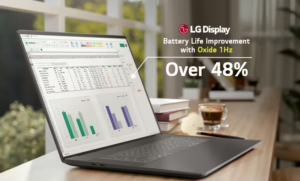
LG Display has begun mass production of a laptop LCD panel capable of running at refresh rates as low as 1Hz, the company announced, a world first in shipping panel technology, and a direct challenge to the narrative that OLED has already won the premium laptop display market.
The panel, built on LGD’s proprietary Oxide 1Hz architecture, spans 1Hz to 120Hz in variable refresh rate, driven entirely by on-screen content. A static spreadsheet or PDF pulls the display to near-standstill; a video or animated interface drives it back to 120Hz. No user input required. LGD claims up to 48% improvement in battery life versus conventional fixed-rate LCD panels.
The first commercial application is already shipping. Dell’s XPS 14 (2026), unveiled at CES in January, carries the Oxide 1Hz panel as its base display configuration. Independent testing has produced numbers that the display industry will be examining closely.
Tom’s Hardware, running a standardized web browsing battery test, logged 20 hours and 41 minutes on the XPS 14 equipped with the LGD LCD. The same chassis configured with LGD’s tandem OLED panel, tested under identical conditions, returned 12 hours and 23 minutes. That is an 8-hour-plus delta between two premium panels in the same notebook, from the same panel supplier.
Tom’s Guide reported up to 31 hours of streaming battery life and more than 40 hours of local video playback in Dell’s own testing conditions. TechRadar noted that the LCD panel itself is 30% more power-efficient than the display used in the prior-generation XPS models, with the 1Hz VRR delivering additional savings on top of that baseline improvement.
A methodological note is warranted. The LCD version of the XPS 14 pairs with Intel’s Panther Lake chip, a power-optimized configuration. The OLED variant ships with the higher-performance Intel Core Ultra X7 358H. The full battery advantage is not attributable solely to the display; the chip pairing contributes. The directional result, however, is not in dispute.
The problem that LGD’s technology solves is structural to how conventional LCD backplanes work. Standard a-Si or LTPS TFT panels cannot hold pixel charge long enough at very low refresh rates. Charge leaks from the pixel capacitor, producing image degradation or visible flicker as the panel compensates. Most LCD panels can descend to roughly 48Hz before artifacts become unacceptable.
LGD’s approach replaces the conventional TFT material with a metal oxide semiconductor selected specifically for minimal charge leakage at low refresh. The oxide transistor holds electrical state significantly longer, enabling stable pixel data at 1Hz without visual artifacts. LGD combined this material choice with two additional proprietary elements: custom circuit algorithms that monitor on-screen activity and trigger refresh rate transitions, and proprietary panel design architecture governing how pixel circuits manage charge-hold timing.
Ars Technica characterized the technology as “LTPO-like” in their coverage, which is accurate in outcome but imprecise in mechanism. True LTPO, the hybrid TFT stack used in Apple Watch and premium smartphone OLED displays, combines LTPS transistors for high-frequency driving with oxide TFTs for low-frequency data-holding in the same pixel circuit. LGD’s Oxide 1Hz is an all-oxide single-layer backplane, not a dual-layer LTPS-plus-oxide hybrid. The architecture achieves the same 1Hz capability through a different path, one that is technically less complex to manufacture at scale on existing oxide LCD fab lines. For display manufacturers, that distinction has direct implications for cost and yield.
LGD is not the only company pursuing 1Hz laptop displays, but it is the first to ship at volume. In October 2025, Intel and BOE jointly announced a competing 1Hz laptop display collaboration, Intel’s Intelligent Display Technology 2.0 paired with BOE’s panel, claiming up to 65% reduction in display power consumption, a figure that exceeds LGD’s 48% claim.
The Intel-BOE approach uses LTPO, the full LTPS-plus-oxide hybrid stack, rather than LGD’s all-oxide architecture. LTPO is more complex to manufacture at scale on LCD fab lines. More immediately relevant to the 2026 laptop design cycle: BOE’s panel is not expected until late 2026. LGD’s mass production is running now.
OEM panel design wins are typically locked six to twelve months ahead of product launch. LGD’s head start on the Dell XPS 14, with mass production underway in March 2026, effectively secures the premium tier of the 2026 PC refresh cycle before BOE’s technology reaches commercial availability.
Apple and the 1Hz Ceiling
The Apple reference point is unavoidable in any premium laptop display discussion. Current MacBook Pro models, built on miniLED LCD with M4 and M5 chips, floor at approximately 48Hz minimum refresh, far above what LGD is now shipping in volume. Current iPad Pro, running tandem OLED with LTPO, steps down to 10Hz. Neither product reaches 1Hz.
Rumors and supply chain reports suggest Apple is developing an OLED MacBook Pro with 1Hz ProMotion capability, potentially in late 2026 or 2027. If that product ships, LGD’s current technology claim shifts from “world first” to “best-in-class LCD.” That would remain a commercially meaningful position: LCD holds roughly 90% of the IT panel market and is projected to remain near that share through 2030, even accounting for continued OLED penetration in premium notebooks.
LGD CEO Jung Cheol-dong, speaking at CES 2026, expressed caution about committing to a full 8.6G IT OLED fab investment, stating that “the market is not yet large enough in economic scale” and indicating the company plans to “respond with existing infrastructure.” The Oxide 1Hz announcement is the operational expression of that position: extend the pricing power and differentiation of premium LCD rather than cede the tier immediately to OLED.
That positioning is being tested in real time by the XPS 14 review cycle, with results that support the thesis. At typical mixed productivity workloads, the 1Hz LCD is posting close to double the battery runtime of the tandem OLED in the same chassis. The conventional industry narrative, that OLED’s per-pixel light control gives it a power efficiency edge at typical laptop brightness levels, runs into difficulty when the competing LCD can shed the majority of its refresh rate during the substantial portions of productive use that involve static content.
| Configuration | Display | Resolution | Battery (Tom’s Hardware web test) |
| XPS 14 2026 (LCD) | LGD Oxide 1Hz | 1920×1200 (2K) | 20 hr 41 min |
| XPS 14 2026 (OLED) | LGD Tandem OLED | 2880×1800 (3K) | 12 hr 23 min |
| MacBook Pro M5 | miniLED LCD | n/a | ~18 hours |
AI PCs and the Power Budget
LGD’s press release explicitly names the AI PC transition as a demand driver for the technology, noting that “the recent increase in AI computational tasks driving up power consumption” positions Oxide 1Hz panels for greater prominence. The argument has merit beyond marketing language.
On-device AI inference running on NPUs creates sustained background compute loads that were not present in laptops two years ago. The display panel has long been among the top power consumers in a notebook alongside the processor. Adding persistent NPU activity compresses the available power budget for every other component. A panel that can significantly reduce draw during static-content use, which represents a substantial share of knowledge worker laptop hours, directly offsets that new NPU load. Windows 11’s AI-based power management updates have also identified the display as a primary savings target, creating software-level convergence with what LGD is delivering at the panel level.
The most strategically loaded sentence in LGD’s announcement may be the briefest. The company stated it is “preparing to begin mass production of a 1Hz OLED panel incorporating the same technology from 2027.”
The technical meaning: LGD will apply its oxide TFT circuit design and algorithm IP to an OLED backplane, producing a panel that combines OLED image quality, perfect blacks, wide color gamut, infinite contrast, with true 1Hz variable refresh. The specification would be directly comparable to what Apple’s LTPO OLED achieves in iPhone and iPad Pro, applied now to a laptop panel. The fact that LGD is committing to the 2027 roadmap publicly while simultaneously demonstrating the enabling technology in mass production today gives the announcement credibility beyond a roadmap slide.
It also maps onto the stated strategy of avoiding a large new greenfield 8.6G fab investment. A 1Hz OLED laptop panel targeting 2027 would most plausibly be produced on LGD’s existing generation 6 or 8th-gen OLED lines for IT applications, consistent with the CEO’s “existing infrastructure” framing.
The product that closes that gap on Apple’s ProMotion narrative for future Macs is now a documented technology program with a committed timeline, not a speculative capability.