
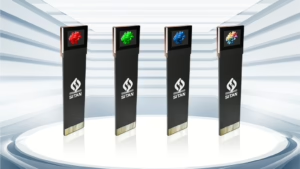
A Shenzhen-based MicroLED developer closing a relatively modest funding round would normally draw little attention. Sitan Technology’s B3 round of nearly 100 million yuan, roughly $14.5 million, closed with participation from Xiamen Advanced Manufacturing No. 1 Fund, Xiamen Science City Mother Fund, Industrial Capital, and Longhua Capital, bringing Sitan’s total Series B funding to more than $30 million. By the standards of a semiconductor buildout, that is not a large number.
What makes it interesting is where it fits. Look across the MicroLED investment landscape of the past eighteen months and a pattern emerges that is the opposite of the narrative that dominated CES demo floors for years. The capital is not chasing 100-inch televisions. It is chasing millimeters.
Sitan operates a pilot production line in Longhua, Shenzhen, and focuses exclusively on microdisplays for AR smart glasses, automotive head-up displays, and projection modules. The company’s integrated approach, covering epitaxy through finished modules, is a textbook example of how Chinese capital is building vertically consolidated positions in MicroLED microdisplay supply chains, treating them as strategic infrastructure for AR optics and automotive systems rather than consumer display novelties.
The company has secured development contracts with top-tier automotive clients for MicroLED automotive modules, and has signed early mass production orders for those modules. On the AR side, it is beginning to produce green monochrome microdisplays with initial customer orders in hand. The combination of design wins, early production orders, and continued investor backing at a time when much of the broader MicroLED industry is still sorting out its economics tells a story about where near-term commercial traction actually is.
Big Checks for Tiny Engines
Sitan is not an outlier. It is the latest addition to a group of well-funded “micro-engine” companies, each targeting a high-value application where MicroLED’s brightness, efficiency, and form-factor advantages justify the still-elevated cost of the emitters.
Shanghai-based JBD completed its Series B2 round at $140 million, led by Hundun Investment and CITIC Jingshi, with previous backers including CITIC Securities, Lightspeed China Partners, and Yinbai Investment. JBD is the first company to achieve mass production of MicroLED microdisplays and has reported design wins with Xiaomi, TCL, Alibaba, and Vuzix, among others. Its latest platform, the Roadrunner series, achieves a pixel pitch of 2.5 microns and 10,160 PPI, with a phased market rollout expected in the second half of 2026.
On the Western side of the ledger, Mojo Vision took a different path to reach a similar destination. The company raised $75 million in an oversubscribed Series B Prime round led by Vanedge Capital, with participation from NEA, Khosla Ventures, Dolby Family Ventures, and new investors including imec.xpand. Mojo started as a smart contact lens developer, raised more than $200 million on that premise, then pivoted sharply after discontinuing the contact lens program in 2023. The Cupertino company has since concentrated on a MicroLED platform combining 300mm GaN-on-silicon emitters, quantum dots for color conversion, and microlens arrays, targeting high-resolution microdisplays for AR glasses and automotive applications.
Avicena stretches the category further. The Sunnyvale-based company raised $65 million in a Series B led by Tiger Global, with participation from SK Hynix, Lam Research, Hitachi Ventures, and Maverick Silicon, bringing its total capital raised to $120 million. Avicena is not building displays at all. Its LightBundle platform uses dense GaN MicroLED arrays integrated on silicon drivers to deliver chip-to-chip optical interconnects at over 1 Tbps per millimeter of shoreline density, at sub-picojoule-per-bit efficiency levels. The target customers are AI data centers, where the energy cost of moving data between GPU clusters is becoming an acute problem. The MicroLED emitter, in this framing, is a photonic component, not a display element. Investors are apparently comfortable with that framing, given the round was oversubscribed.
The 2027 Anchor
What unifies the investment rationale across all of these companies is a mid-decade demand horizon, and Meta has supplied the clearest public marker for it. Meta is targeting a late-2027 launch for MicroLED-based AR glasses, replacing the LCoS display engine used in its current Ray-Ban Display product with RGB MicroLED microdisplays sourced from external partners. The company has posted engineering roles to oversee the production ramp of RGB MicroLED chips, covering epitaxy through device fabrication and end-of-line testing.
That is a significant signal. The current Ray-Ban Display, which shipped in late 2025, uses an LCoS panel from Omnivision because MicroLEDs are not yet mature enough for a mass-market device at that cost point. Meta’s decision to actively staff and prepare a MicroLED microdisplay ramp for a late-2027 product is one of the first confirmations from a Tier-1 platform owner that MicroLED microdisplays are expected to reach consumer hardware viability on that timeline. Sitan, JBD, Mojo, and Avicena are all, in different ways, positioning their production and product cycles around that window.
Supplying the 2027 ramp requires foundational work happening at the epi and wafer level. Two developments from early 2026 are relevant here.
France’s Aledia announced the commercial availability of its FlexiNova platform, claiming to be the first company to manufacture 3D nanowire-based MicroLEDs operating at 6V, with a chip size of 15 by 30 microns, produced on 200mm silicon wafers. The company, working with CEA-Leti, is developing a portfolio at 6V and 9V operation with devices down to 3.5 microns, maintaining efficiency at smaller sizes. The pitch to the industry is high-voltage operation that simplifies the backplane and optics stack, which matters considerably in microdisplay and automotive light-engine designs.
Meanwhile, ALLOS, a Dresden-based GaN-on-silicon epi specialist, announced a strategic partnership with Taiwan’s Ennostar to bring 200mm GaN-on-Si MicroLED wafers to volume production, with a roadmap toward 300mm. Both companies claim that GaN-on-Si epi performance has reached parity with GaN-on-sapphire while retaining full compatibility with silicon fab infrastructure, removing one of the longstanding objections to the approach. These are the picks-and-shovels plays that underpin the 2026-to-2028 production window: without wafer formats and processes that integrate cleanly with silicon backplanes, the microdisplay ramp cannot happen at scale.
The Equipment Cycle
One honest counterweight to this investment narrative comes from the equipment side. Aixtron, whose metal-organic CVD tools are central to MicroLED epitaxy, reported that its MicroLED business saw a slowdown in 2025 and expects 2026 to be similar. The company still regards MicroLED as a medium-term growth driver, but the heavy equipment ordering cycle that would signal a broad industry production ramp has not yet materialized. Many customers have continued to focus on yield optimization and process development rather than committing to production-scale tool orders, particularly for large-format TV applications.
That lag is itself informative. The microdisplay and photonic interconnect companies building toward 2027 are doing so on smaller, more specialized production lines, not the kind of high-throughput fabs that would show up conspicuously in Aixtron’s order book. The capital is ahead of the equipment cycle because the applications driving it do not require the same scale.
Money Talks
The geographic split in this investment picture has its own logic. China is constructing vertically integrated microdisplay champions, with JBD already in volume production and Sitan scaling behind it. The US, Europe, and Taiwan are building IP and platform plays, from Mojo’s GaN-on-silicon process and Aledia’s nanowire architecture to Avicena’s photonic interconnect position, each tuned to AR, automotive, or data center photonics where licensing and system value can support the economics.
Taken together, these funding rounds and platform announcements describe an industry making a deliberate bet that MicroLED’s first commercially meaningful chapter will not be written on living-room screens. The displays and emitter arrays drawing the real investment are the ones measured in fractions of an inch, not fractions of a meter, and the money seems to have decided the two-year horizon is when they start paying off.