

LG Display has secured what it describes as the display industry’s first ‘100% dimming consistency’ verification, awarded by UL Solutions, the global applied safety and testing organization. The certification covers all of LG Display’s current large-area OLED panels including 2026 TV and monitor products and arrives at a moment when Chinese panel makers are pressing aggressively into high-zone MiniLED and early Micro RGB territory.
The timing is not coincidental. LG Display occupies the dominant position in large-area OLED supply, but the gap between premium OLED sets and the best MiniLED LCD products has narrowed considerably in perceived picture quality over the past two years. The UL verification is, in effect, a strategic document: an objective, third-party claim staked in territory where OLED’s physics give it a structural advantage.
What ‘Dimming Consistency’ Actually Measures
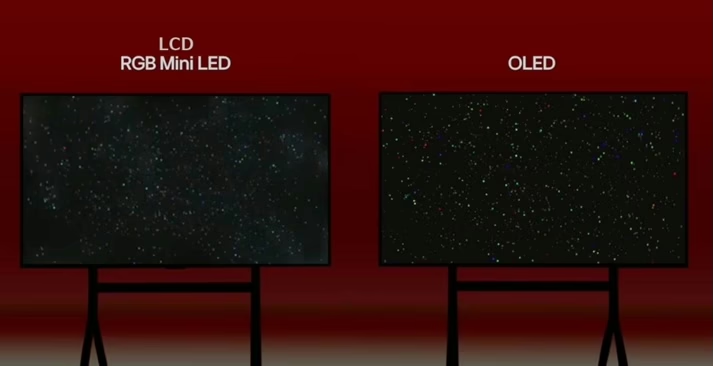
UL’s test methodology is straightforward in concept, if precise in execution. A reference window is placed at the center of a panel, initially covering one-tenth of the total screen area. The window is then progressively shrunk to 11/1000, 5/1000, and finally 2/1000 of the panel — an area roughly the size of a bright highlight, a specular reflection, or a star in a dark sky. At each step, UL measures maximum and minimum luminance inside the window.
If the measured brightness range remains unchanged as the window shrinks, dimming consistency is 100%. If the brightness drops or shifts as the window narrows, indicating that the panel’s backlight or local dimming zones cannot maintain consistent output at very small average picture levels, the score falls accordingly.
LG Display’s OLED panels held at 100% across all window sizes. LCD-based panels tested under the same methodology ranged from 83% at best to 43% in some cases — a spread that reflects the fundamental trade-offs in zone-controlled backlighting.
The Physics Behind the Numbers
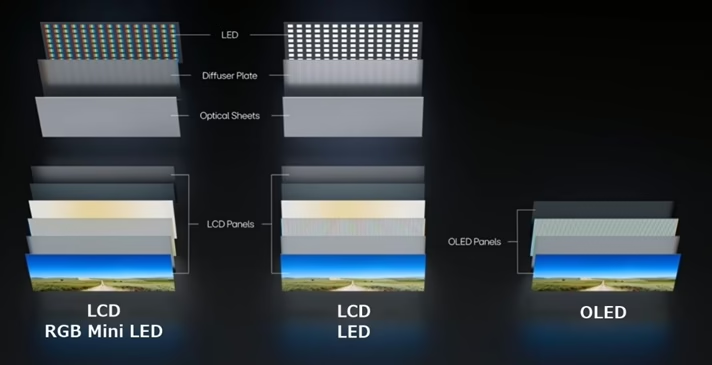
The reason OLED reaches 100% is structural, and critics of the test’s design are right to point that out. OLED panels emit light at the pixel level. Each pixel on an LG Display panel measures approximately 0.1 mm² and functions as its own independent light source. When the UL reference window shrinks to 2/1000 of the screen, those pixels continue to emit at their programmed brightness, because no external zone control or backlight management is involved. There is nothing to drift.
RGB MiniLED LCD, the technology LG Display is explicitly targeting, operates through backlight blocks that are — in LG’s own comparative data, between 160,000 and 830,000 times larger than an OLED pixel. When a very small bright object must be rendered on a MiniLED display, the dimming zone surrounding that object is necessarily much larger than the object itself. Brightness rolls off toward zone boundaries, producing the visible halos that have long been MiniLED’s most-discussed artifact, and causing average luminance in a small measurement window to fall as zone edges intrude.
TechRadar’s review team, which has covered the certification extensively, puts the critique plainly: this test is effectively asking ‘Is this an OLED?’ But acknowledging that framing does not diminish the underlying reality. Pixel-level dimming does produce measurably more consistent contrast at small window sizes. The certification codifies something display engineers have known for years and gives LG a clean, defensible number to take to retailers and OEM partners.
Primary RGB Tandem 2.0: Brightness Joins Consistency
The dimming consistency certification lands alongside LG Display’s rollout of its Primary RGB Tandem 2.0 WOLED architecture, unveiled on an 83-inch panel at CES 2026. The structure stacks independent red, green, and blue OLED emitter layers, uses a refined pixel layout, and applies advanced driving algorithms designed to maximize luminous efficiency and long-term panel life.
The result is a panel capable of up to 4,500 nits of peak brightness, roughly double what LG Display’s previous flagship WOLED panels could achieve in small-window highlights, alongside approximately 99.5% DCI-P3 color gamut coverage. LG pairs that with a ‘Perfect Black AR’ anti-reflection coating, rated at 0.3% reflectance — a figure the company claims is the lowest across any consumer TV category today.
For 2026, the Tandem 2.0 panel anchors the LG OLED G6 lineup in 55- to 83-inch screen sizes, where it is branded ‘Hyper Radiant Color’ and paired with LG Electronics’ Alpha 11 Gen 3 AI processor and Brightness Booster Ultra processing. Monitor variants using Tandem WOLED are expected to reach up to 1,500 nits and qualify for VESA True Black 500 certification.
What the 43–83% Range Means for Chinese MiniLED
The competitive context matters here as much as the test results. Chinese TV brands TCL, Hisense, and several others, have invested heavily in high-zone MiniLED architectures as their primary quality argument against Korean OLED in the premium segment. Their proposition is straightforward: more dimming zones mean tighter halo control, and higher peak brightness numbers make for compelling retail-floor comparisons.
The UL dimming consistency data, which UL tested across LCD panel categories without specifying the exact zone counts or vendors, suggests that even the best MiniLED implementations top out at 83% by this measure. LG Display and its OEM partners will deploy that number in marketing materials and retail training through 2026, particularly in markets where MiniLED vendors lead with peak-nit claims.
The honest caveat, acknowledged by both LG’s own engineers and independent reviewers, is that real-world viewing scenarios often flatter MiniLED more than the 43–83% consistency range implies. Backlight zone counts have risen sharply, dynamic dimming algorithms have improved, and content that actually exercises the test’s worst case, a tiny bright highlight on a pure-black field, is a fraction of everyday viewing material. The question is whether the certification shifts consumer perception in showrooms, even if it does not fully reflect the median viewing experience.
The Awkward Question Samsung Is Now Facing
UL’s test covered LCD-based panels but notably did not include Samsung Display’s QD-OLED, which is also a self-emissive technology and would, by the same physical logic, be expected to score at or very near 100% dimming consistency. The omission has not gone unnoticed in the display press. Whether it reflects test scope, timing, or a deliberate framing decision by LG Display is unclear.
What it does do is hand Samsung Display an opening. If QD-OLED panels achieve equivalent dimming consistency, and the physics strongly suggest they should, Samsung could pursue its own UL verification or commission comparable third-party testing, effectively nullifying LG Display’s ‘industry first’ framing. The competitive response will be worth watching in the second half of 2026.
More broadly, the certification previews where premium TV competition is heading. As MicroLED and Micro RGB emissive panels begin entering the addressable market at prices that remain far above consumer television ranges, but declining dimming consistency will become a floor, not a differentiator. All emissive technologies share the structural advantage. The next battleground will be brightness efficiency, color volume, panel lifetime, and, critically, cost per square inch.
Strategic Calculus for Korea
For LG Display, the combination of 4,500-nit peak brightness, 0.3% reflectance, and a certified 100% dimming consistency score gives it a three-part quality narrative that no single competitor can currently match across all three dimensions. That narrative is designed to sustain premium pricing for LG Electronics’ G6 and flagship WOLED lines through a product cycle in which Chinese brands are likely to close further on raw specification comparisons.
Hyeon-woo Lee, head of LG Display’s Large Display Business Unit, framed the certification as a clarity exercise: ‘We have objectively identified why OLED appears brighter and clearer.’ Whether or not ‘optimal choice in the AI era’ lands as a consumer message, the underlying measurement is sound. LG Display has put a number on a quality attribute that has been qualitatively understood for years, and gotten a credible third party to stamp it.
In a category where the spec-sheet gap between OLED and MiniLED has narrowed, that may be exactly the kind of certified, specific, and defensible claim LG needs heading into the 2026 selling season.