
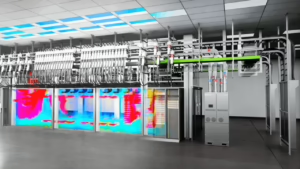
LG Display has developed a digital twin tool for OLED panel development and production built on Nvidia’s PhysicsNeMo platform. The system, called the Digital Panel Solution (DPS), was disclosed at Semicon Korea 2026, where Nvidia Korea CEO Jung So-young presented the project and identified LG Display as the only company in Korea currently applying PhysicsNeMo in an actual display manufacturing environment.
LG Display developed the DPS in partnership with Korean AI startup ALSEMI, with joint research on physics-based AI for OLED processes dating back roughly four years. Nvidia supplied GPU-accelerated infrastructure and the PhysicsNeMo engine. Development of the DPS has now been completed, according to the partners.
The DPS represents a shift from conventional simulation-driven digital twins to a physics-trained AI model. Traditional digital twin tools in display manufacturing take input values such as material properties and thermal conditions, then run numerical calculations for each scenario. When design conditions change, models must be recomputed from scratch, making iterative optimization slow and resource-intensive.
LG’s approach embeds the physics into an AI model trained on two data sources: prior simulation results and real manufacturing data from LG Display’s OLED production lines. Rather than re-running full numerical simulations when conditions change, the trained model predicts process behavior and device performance for new inputs. Nvidia notes that software-level optimizations in PhysicsNeMo can cut base-model training and fine-tuning time by up to a factor of two.
LG Display expects the DPS to derive optimal process conditions more quickly, minimize trial-and-error in experiments through AI-based predictions, and shorten overall development schedules by forecasting process and device outcomes ahead of physical verification. As the model ingests new process and product data, the company says it will refine both the underlying data and the model itself.
The PhysicsNeMo-based DPS is new, but LG Display has published quantifiable results from earlier, separate AI systems deployed in OLED manufacturing that provide context for the types of gains the company is targeting.
A previously disclosed AI system deployed on LG Display’s OLED production lines provides real-time alerts and suggested solutions for quality anomalies. LG Display reported that this system reduced the time required to analyze and address quality issues from an average of about three weeks to two days, with estimated annual savings of roughly 200 billion Korean won (approximately $140 million).
In display design, LG Display has applied AI to the creation of compensation patterns for irregularly shaped panels, a task that previously required about one month of manual design work. The AI-assisted process has reportedly reduced that to around eight hours. LG Display has labeled this broad AI rollout across development, production, and administration as the inaugural year of its “AX (AI Transition) innovation.”
The LG Display project aligns with Nvidia’s “AI factory” strategy for advanced manufacturing, a framework Nvidia describes as a physics-AI-based manufacturing stack spanning the product lifecycle from design through production. For Nvidia, adoption by leading global manufacturers is a key success factor for this initiative, and LG Display is being positioned as a flagship example in the display sector.
Export controls and the U.S.-China technology conflict have made it difficult for many Chinese companies to adopt Nvidia’s latest platforms at scale, which has led Nvidia to place particular emphasis on success stories from non-Chinese manufacturers.
LG Display has indicated that the DPS is intended as a foundation for a broader AI-driven control layer across OLED development and mass production. The company plans to extend its digital twin technology into what it describes as an “agency AI system” capable of optimizing the entire panel development and manufacturing process. Once deployed into full mass production environments, LG Display expects such systems to contribute to improved yield rates in OLED panel manufacturing.